

Classic Mustang engine maintenance is the practice of servicing 1964½–1973 Ford Mustang powertrains using procedures, fluids, and inspection intervals calibrated to vintage engineering rather than modern automotive standards. These engines predate electronic fuel injection, roller-follower camshafts, and self-adjusting ignition systems, so many maintenance tasks require a different approach that contemporary service schedules simply do not match.
This guide covers what makes vintage V8 upkeep distinct, the core routine service tasks every classic Mustang owner needs to follow, fluid selection and specification requirements, carburetor and cooling system care, ignition maintenance, common engine problems and how to prevent them, proper winterization and storage, and how reproduction Mustangs with modern drivetrains change the maintenance picture entirely.
Vintage V8 engines carry material vulnerabilities modern engines do not: ethanol-blended fuels degrade rubber lines and cork gaskets, flat-tappet camshafts require zinc-fortified oil, and ignition timing demands manual calibration with a timing light rather than automated correction.
Routine service covers oil changes around 3,000-mile cycles, spark plug inspections, distributor cap and rotor checks, ignition points replacement, valve lash adjustment, timing chain monitoring, coolant flushes, and fuel filter service, each tied to its own interval and condition triggers.
Carburetor and cooling system health are also closely linked to fuel quality and ethanol exposure. Common failure patterns including oil leaks, overheating, vapor lock, and rough idle each trace back to age-related material degradation or fuel incompatibility, and all respond well to targeted prevention.
Reproduction Mustangs built with modern EFI powertrains, such as those reengineered vehicles from Revology Cars, eliminate most vintage-specific maintenance burdens while preserving the classic aesthetic.
What Makes Classic Mustang Engine Maintenance Unique?
Classic Mustang engine maintenance is unique because these vehicles combine aging mechanical systems, obsolete materials, and vintage engineering philosophies that modern service intervals and products were never designed to address. The sections below cover how vintage V8 design creates distinct upkeep challenges, why carbureted systems demand extra care, and how accumulated age and mileage shape a classic Mustang’s specific maintenance needs.
How Do Vintage V8 Engines Differ From Modern Engines in Upkeep?
Vintage V8 engines differ from modern engines in upkeep primarily because their original components, ventilation systems, and fuel tolerances were engineered decades before contemporary fuels, lubricants, and diagnostic tools existed. For example, some 1964 289 engines used timing cover oil filler tubes for crankcase ventilation, while others relied on PCV valves or draft tubes, meaning even two engines of the same year may require different service approaches.
Fuel compatibility is a critical concern. Older engines face degradation in rubber parts, cork gaskets, and exposed magnesium or aluminum surfaces when exposed to ethanol-blended fuels, according to Oklahoma State University Extension research. Ignition setup also demands hands-on precision: basic timing for Ford V8 engines requires a timing light at idle with the vacuum advance line disconnected and plugged, a procedure modern engine management systems handle automatically.
Why Do Carbureted Classic Mustang Engines Require Special Attention?
Carbureted classic Mustang engines require special attention because carburetors are mechanical fuel-metering devices with no electronic compensation, meaning they respond directly to every change in fuel quality, air temperature, altitude, and component wear. Unlike modern fuel injection systems, a carburetor cannot self-adjust for ethanol content, atmospheric pressure shifts, or gradual jet wear.
Industry specialists recommend draining engine oil every 3,000 miles for conventional or mineral-based oils in classic engines, a cadence that reflects the broader sensitivity of these powertrains to fluid degradation. Problems primarily associated with carburetor systems include fuel varnish, float bowl evaporation, and accelerator pump deterioration as common failure points that require periodic inspection rather than simple interval-based replacement.
How Does Age and Mileage Affect a Classic Mustang Engine’s Needs?
Age and mileage affect a classic Mustang engine’s needs by progressively degrading seals, bearings, gaskets, and internal clearances in ways that shift maintenance from scheduled service to condition-based assessment. In 2020, the United States held the largest global share of the classic car market, a sector influenced significantly by vehicle age, restoration level, and mileage, according to MDPI research. A high-mileage engine that has never been rebuilt carries different risks than a low-mileage unit stored for decades, where dried seals and fuel varnish pose greater immediate threats than wear.
Classic Mustang owners estimate performing at least one minor mechanical fix every three months on average to maintain reliability. This reality reflects why age and mileage together, not either factor alone, determine the actual maintenance burden of any individual classic Mustang engine.
What Are the Most Important Routine Maintenance Tasks for a Classic Mustang Engine?
The most important routine maintenance tasks for a classic Mustang engine include oil changes, spark plug replacement, ignition service, valve lash adjustment, timing chain inspection, coolant flushes, and fuel filter replacement. Each task follows its own interval and directly affects engine longevity.
How Often Should You Change the Oil in a Classic Mustang?
Oil changes on a classic Mustang should happen around every 3,000 miles when using conventional or mineral-based oil, or every 3,000 to 5,000 miles with a high-quality synthetic-blend product, according to industry specialists. The 1965–1973 Windsor 289 engine as one example holds 5 quarts including the filter. Because flat-tappet camshafts need a heavy enough film of oil to survive, skipping changes accelerates cam and lifter wear faster than nearly any other oversight.
When Should You Replace Spark Plugs on a Classic Mustang Engine?
Spark plugs on a classic Mustang engine should be inspected every 10,000 to 12,000 miles and replaced when electrodes show erosion, fouling, or carbon buildup. Plug condition also serves as a diagnostic tool: oil fouling points to worn rings or valve seals, while white deposits suggest a lean mixture. According to Driven Racing Oil, ZDDP forms a protective phosphorus-based film over metal parts when the engine heats up, reducing metal-to-metal contact wear — making clean combustion from healthy plugs even more critical for engine survival.
How Frequently Should You Inspect and Replace the Distributor Cap and Rotor?
The distributor cap and rotor on a classic Mustang should be inspected at least once per season and replaced around every 12,000 to 30,000 miles, or immediately if cracking, carbon tracking, or corrosion is visible. These components degrade from heat cycling and moisture exposure, both of which are routine in a vintage engine bay. A worn rotor or cracked cap causes misfires that stress the entire ignition and fuel delivery system downstream.
What Is the Correct Interval for Replacing Classic Mustang Ignition Points?
The correct interval for replacing classic Mustang ignition points is every 10,000 to 15,000 miles, though many owners inspect them around every 5,000 to 7,500 miles given how quickly gap wear affects timing accuracy. Points control the dwell angle that determines spark timing; as the rubbing block wears, the gap closes and timing retards. Millers Oils recommends an optimum ZDDP level of 1,000 to 1,400 ppm in the engine oil to protect the cam lobes that the distributor drive gear contacts — a reminder that ignition and lubrication health are connected.
How Often Should You Check and Adjust Valve Lash on a Classic Mustang?
Valve adjustment (lash on solid lifter engines or preload on hydraulic lifter engines) is especially important after cylinder head or valvetrain work, since changes in head machining, gasket thickness, or component geometry can alter lifter position and rocker geometry. These settings are typically verified again after initial engine break-in. Valve lash on a classic Mustang should also be checked every 10,000 to 15,000 miles on engines with adjustable rocker arms, or any time a rough idle or ticking develops that cannot be traced to the ignition system. Incorrect lash causes valves to either float at high RPM or seat incompletely, both of which reduce power and accelerate seat wear.
When Should the Timing Belt or Chain Be Inspected on a Classic Mustang?
The timing chain on a classic Mustang should be inspected every 30,000 to 50,000 miles, or whenever slack, rattle on cold start, or a wandering idle suggests wear. Classic Mustang V8 engines use a timing chain rather than a belt, so there is no rubber component to degrade from ozone or heat alone. However, worn chain stretch shifts cam timing, which directly impacts idle quality, fuel economy, and power delivery across the RPM range.
How Often Should You Flush and Replace the Coolant on a Classic Mustang?
Coolant on a classic Mustang should be flushed and replaced every two years regardless of mileage, because silicate inhibitors deplete over time even in a stored vehicle. While many 1964½ Mustangs were 6-cylinders, the 8-cylinder 1964½ Mustang cooling system for example holds approximately 14.5 quarts including the heater circuit, so a proper flush requires enough replacement coolant to fill the entire system. Using the wrong coolant chemistry can accelerate electrolytic corrosion in copper-brass radiators, which are common in early Mustangs.
When Should You Replace the Fuel Filter on a Classic Mustang?
The fuel filter on a classic Mustang should be replaced every 20,000 to 30,000 miles to ensure consistent fuel delivery to the carburetor. Owners using ethanol-blended pump fuel should inspect the filter more frequently, because ethanol acts as a solvent that dissolves old varnish and dirt deposits throughout the fuel system, sending particulates directly into the filter and carburetor. Depending on the specific year and trim, the 289 V8 variant was designed with a compression ratio of around 8.7:1 to 9.3:1 and the 302 variant with a compression ratio around 9.5:1 to 10.5:1, both with carbureted fuel delivery, meaning any restriction at the filter creates an immediate, measurable drop in performance.
With a solid routine maintenance schedule in place, the next step is choosing the right fluids to support each of these systems.
What Engine Fluids Does a Classic Mustang Need Regular Attention?
Classic Mustang engine fluids requiring regular attention include motor oil, coolant, and fuel system fluids. The sections below cover the correct specifications, zinc additive requirements, coolant compatibility, and ethanol-related fuel system considerations for 1964½–1973 Mustangs.
What Type of Oil Is Best for a Classic Mustang Engine?
The best oil for a classic Mustang engine is a high-zinc conventional or mineral-based motor oil formulated specifically for flat-tappet camshaft engines. Modern API-rated oils have reduced ZDDP levels to protect catalytic converters, which classic Mustangs do not use, making them unsuitable as the sole protection for vintage valvetrains. A dedicated classic car oil or a ZDDP-supplemented product is the more protective choice.
Does a Classic Mustang Engine Require Zinc Additive in Its Motor Oil?
Yes, a classic Mustang engine does require zinc additive in its motor oil. According to Driven Racing Oil, ZDDP forms a protective phosphorus-based film over metal parts as the engine heats up, directly reducing metal-to-metal contact wear on flat-tappet camshafts and lifters. Classic Motorsports specialists recommend changing conventional or mineral-based oils every 3,000 miles, or 3,000 to 5,000 miles for synthetic-blend products.
What Coolant Type Is Compatible With a Classic Mustang Radiator and Engine?
The coolant type compatible with a classic Mustang radiator and engine is a conventional green ethylene glycol coolant mixed 50/50 with distilled water. While modern OAT and HOAT coolants are not inherently incompatible, they are typically avoided in vintage systems unless the cooling system has been fully converted to aluminum parts and maintained with a single coolant chemistry. Copper-brass radiators, common on classic Mustangs, are susceptible to electrolytic corrosion from incompatible modern coolant chemistries. According to MotorTrend, overheating in 1965-1966 Mustangs often results from restricted airflow through the radiator or improper engine rebuild tolerances, making coolant quality and system cleanliness equally important.
How Should You Maintain the Fuel System Fluids on a Classic Mustang?
Fuel system maintenance on a classic Mustang centers on managing ethanol exposure. The Renewable Fuels Association notes that older fuel system materials are significantly more susceptible to ethanol degradation than materials in late-model vehicles, putting rubber lines, cork gaskets, and carburetor components at elevated risk. Key maintenance steps include:
- Use ethanol-free or low-ethanol (E10 maximum) fuel wherever available.
- Replace the fuel filter every 20,000 to 30,000 miles to maintain clean fuel delivery.
- Inspect rubber fuel lines and carburetor inlet needles regularly for softening or swelling caused by ethanol exposure.
- Add a fuel stabilizer during storage to prevent varnish buildup in the carburetor and fuel tank.
With fluid specifications understood, consistent service intervals keep each of these systems performing reliably.
How Do You Maintain the Carburetor on a Classic Mustang Engine?
Carburetor maintenance on a classic Mustang engine covers three core tasks: cleaning and rebuilding on a regular schedule, adjusting the fuel-air mixture for proper combustion, and recognizing warning signs before a minor issue becomes a major failure.
How Often Should You Clean and Rebuild a Classic Mustang Carburetor?
You should clean a classic Mustang carburetor at least once every two years under normal driving conditions, with timelines for a full rebuild varying depending on driving, maintenance, and storage habits and necessary when performance degrades noticeably. Ethanol-blended fuels, driving rarely or only driving seasonally, and storing the vehicle with fuel in the system accelerates this timeline considerably. Because ethanol acts as a solvent that dissolves old varnish and dirt deposits inside the fuel system, it can rapidly clog carburetor passages, jets, and needle valves. A thorough cleaning involves removing the carburetor, disassembling all internal components, and soaking parts in carburetor cleaner before reassembly with a fresh gasket set.
How Do You Adjust the Fuel-Air Mixture on a Classic Mustang Carburetor?
Adjusting the fuel-air mixture on a classic Mustang carburetor requires turning the idle mixture screws gradually while monitoring engine idle speed and smoothness. Start with the screws set 1.5 turns out from lightly seated, then fine-tune in quarter-turn increments until the engine reaches its highest, smoothest idle. From there, reduce idle speed with the throttle stop screw to the manufacturer’s specification. Most classic Mustang V8 engines respond well to careful mixture tuning. An experienced carburetor technician can identify lean or rich conditions by reading spark plug color and observing throttle response.
What Are the Signs That a Classic Mustang Carburetor Needs Immediate Service?
The signs that a classic Mustang carburetor needs immediate service include hard starting, rough idle, excessive fuel smell, black smoke from the exhaust, hesitation during acceleration, and fuel leaking from the carburetor body or float bowl. Any visible fuel leakage is a safety issue requiring immediate attention. A carburetor that floods the engine typically points to a stuck or damaged float needle, while persistent lean running often indicates clogged jets or passages. These symptoms should not be deferred, as a failing carburetor directly affects both reliability and fuel economy. Keeping a rebuilt spare carburetor on hand is a practical approach many experienced classic Mustang owners recommend.
How Do You Keep a Classic Mustang Cooling System in Good Health?
Keeping a classic Mustang cooling system in good health requires regular inspection, timely component replacement, and attention to capacity. The 8-cylinder 1964½ Mustang cooling system holds approximately 14.5 quarts, including 1 quart for the heater. The following sections cover radiator inspection, water pump replacement, and thermostat service.
How Do You Inspect a Classic Mustang Radiator for Leaks and Blockage?
Inspecting a classic Mustang radiator for leaks and blockage starts with a cold-engine visual check of the radiator core, tanks, and hose connections for staining, crusty deposits, or wet spots. Squeeze the upper and lower hoses; soft, spongy, or cracked hoses indicate impending failure. For internal blockage, feel the radiator surface with the engine warm: uneven temperature across the core suggests sediment restricting flow. A pressure test using a cooling system pressure kit is the most reliable method for confirming small leaks that aren’t visible. Copper-brass radiators, common on period-correct Mustangs, can be susceptible to electrolysis, so inspect the coolant condition during every radiator check.
When Should You Replace the Water Pump on a Classic Mustang?
The water pump on a classic Mustang should be replaced when you notice coolant weeping from the pump’s weep hole, bearing play in the pulley, or a grinding noise at the front of the engine. As a preventive measure, many restorers replace the water pump during any major cooling system service or engine rebuild, particularly on vehicles with high or unknown mileage. Because the pump is driven by the fan belt, a seized or failing pump can also cause belt damage. Aluminum impeller pumps used on some replacements can corrode in contact with certain coolant types, so verify compatibility before installation.
How Do You Check and Replace the Thermostat on a Classic Mustang Engine?
Checking and replacing the thermostat on a classic Mustang engine involves removing the thermostat housing at the top of the intake manifold and inspecting the thermostat for corrosion, debris, or a stuck-open or stuck-closed position. A stuck-closed thermostat causes rapid overheating; a stuck-open unit prevents the engine from reaching proper operating temperature, reducing efficiency and increasing wear. To test a removed thermostat, suspend it in a pot of water and heat it: it should open at the temperature stamped on its body, typically 180°F or 195°F. If replacement is warranted, replace the thermostat and housing gasket together. Given how inexpensive thermostats are relative to the damage a failed one causes, replacing it every few years is a sound practice on any driven classic.
With the radiator, water pump, and thermostat addressed, the cooling system is well-positioned to protect the engine reliably through regular driving seasons.
How Do You Maintain the Ignition System on a Classic Mustang?
Maintaining the ignition system on a classic Mustang involves three core tasks: setting timing correctly, evaluating whether to upgrade from points to electronic ignition, and testing the ignition coil. Each sub-section below covers one of these areas in full.

How Do You Check and Set the Ignition Timing on a Classic Mustang?
Ignition timing on a classic Mustang is checked and set using a timing light at idle RPM. Disconnect and plug vacuum advance while setting base timing if specified by the service manual for base timing adjustment. Connect the timing light to the number-one spark plug wire, start the engine, and aim the light at the timing marks on the harmonic balancer. Loosen the distributor clamp bolt, rotate the distributor until the timing mark aligns with the correct degree specification for your engine, then retighten the clamp. Reconnect the vacuum advance line if disconnected after confirming the base timing. Vacuum advance control units can provide additional ignition advance, often in the range around 15 to 20 degrees relative to the crankshaft, so accurate base timing is the essential foundation before vacuum advance factors in.
Should You Upgrade a Classic Mustang From Points Ignition to Electronic Ignition?
Whether to upgrade depends on your priorities. Electronic ignition systems provide more accurate and repeatable spark compared to points-based systems. Points require regular adjustment, and worn points are a common source of rough idle and misfires. High hydrocarbon levels at idle that decrease at higher RPMs often signal an ignition problem worth diagnosing before it worsens. For owners who drive their Mustang regularly, an electronic conversion is a practical reliability improvement. Purists preserving a fully original car may reasonably prefer to maintain the points system as-built. Neither choice is wrong; the decision comes down to whether originality or consistent daily driveability matters more to you.
How Do You Test and Replace the Ignition Coil on a Classic Mustang?
Most classic Mustangs had a traditional distributor-based ignition system that used a single ignition coil. The ignition coil on a classic Mustang is tested using a multimeter to measure primary and secondary winding resistance. Disconnect the coil wire from the distributor cap and the two low-voltage terminals at the coil. Set the multimeter to the appropriate ohms range, then measure resistance across the positive and negative terminals for the primary winding and between the negative terminal and the high-voltage tower for the secondary winding. Values outside the manufacturer’s specified range indicate a failing coil. Symptoms of a weak coil include hard starting, misfires under load, and inconsistent spark. Replacement is straightforward: disconnect the wiring, unbolt the coil from its bracket, install the new unit, and reconnect all terminals securely before testing at idle.
What Are the Most Common Classic Mustang Engine Problems and How Do You Prevent Them?
The most common classic Mustang engine problems include oil leaks, overheating, vapor lock, and rough idle. Each issue stems from age-related wear, material degradation, or fuel system incompatibilities that require targeted prevention strategies.
How Do You Prevent Oil Leaks on a Classic Mustang Engine?
Preventing oil leaks on a classic Mustang engine requires replacing aging gaskets and seals before they fail. Decades-old cork and rubber gaskets, particularly at the valve covers, oil pan, and rear main seal, harden and shrink over time. Use modern neoprene or silicone gaskets as replacements, since these materials resist heat and compression better than original cork. Inspect the timing cover and PCV valve regularly, as blocked crankcase ventilation raises internal pressure and accelerates seal failure. Keeping oil changes on schedule also reduces sludge buildup that can stress sealing surfaces.
What Causes Overheating in a Classic Mustang and How Can You Avoid It?
Overheating in a classic Mustang can be caused by many factors, including obstruction, relatively narrow factory radiators (which can be marginal under higher-performance or high-heat conditions), an engine rebuilt improperly, or transmission issues according to MotorTrend’s vintage Mustang diagnostics guide on overheating, as well as other possible factors. Debris-clogged radiator cores, collapsed hoses, a failing thermostat, and a worn water pump impeller can all restrict coolant flow. Prevention centers on keeping the cooling system clean, replacing hoses and the thermostat on a regular inspection cycle, and verifying fan shroud integrity to maximize airflow at low speeds. A properly rebuilt engine with correct bearing clearances also runs cooler by generating less internal friction heat.
How Do You Prevent Vapor Lock on a Classic Mustang Fuel System?
Vapor lock prevention on a classic Mustang fuel system starts with understanding the fuel you use. According to Grabner Instruments, adding 10% ethanol to gasoline drastically reduces the vapor-to-liquid ratio temperature, raising vapor lock risk in vintage fuel systems. To counter this, route fuel lines away from exhaust heat sources, use heat-shielded or insulated fuel line wrap, and consider an inline electric fuel pump mounted near the tank. For storage, fill the tank with premium fuel and add a fuel stabilizer to prevent evaporation and moisture accumulation during the off-season.
What Causes Rough Idle on a Classic Mustang Engine and How Is It Fixed?
Rough idle on a classic Mustang engine is a symptom of deeper causes, and can signal issues such as ignition faults, vacuum leaks, or carburetor imbalances. High hydrocarbon levels at idle that drop at higher RPMs point specifically to an ignition problem or vacuum leak, a diagnostic pattern confirmed by Ford V8 specialists. Begin diagnosis by inspecting all vacuum lines for cracks, checking carburetor base gasket integrity, and verifying ignition timing. Worn distributor points, fouled spark plugs, or a misadjusted idle mixture screw are equally common culprits. Addressing vacuum leaks first is often the most efficient path, as they affect both idle quality and fuel trim simultaneously.
How Do You Store and Winterize a Classic Mustang Engine Properly?
Storing and winterizing a classic Mustang engine properly requires several targeted steps covering engine preparation, fuel system protection, and recommissioning. The sections below address each phase in sequence.
What Steps Should You Take to Prepare a Classic Mustang Engine for Long-Term Storage?
The steps to prepare a classic Mustang engine for long-term storage include changing the oil, fogging the engine, and protecting exposed components. Fresh oil removes acids and contaminants that corrode internal surfaces during idle periods. According to the Antique Automobile Club of America Forums, fogging an engine with fogging oil is a recommended procedure for long-term storage, coating cylinder walls, rings, and valve stems to prevent rust. After fogging, disconnect the battery, plug the exhaust tips to block moisture and pests, and store the vehicle in a clean, dry environment.
How Do You Protect a Classic Mustang Fuel System During Winter Storage?
Protecting a classic Mustang fuel system during winter storage centers on stabilizing the fuel before the car is laid up. According to the 7173Mustangs Forum, fuel stabilizer should be added so it circulates through the entire fuel system, reaching the carburetor and fuel lines before storage begins. Once home, top off the tank with fresh premium fuel to minimize the air space where condensation forms. NIST research has highlighted that ethanol blends increase corrosion risk in fuel system components, making stabilizer use especially important for vintage carbureted systems.
What Should You Do When Recommissioning a Classic Mustang Engine After Storage?
Recommissioning a classic Mustang engine after storage requires a systematic inspection before the first start. Key steps include:
- Replace the oil and filter if it was not changed at storage time.
- Inspect belts, hoses, and coolant level before cranking.
- Remove spark plugs and add a small amount of engine oil to each cylinder, then crank the engine briefly without starting to redistribute oil before firing.
- Check that the fuel stabilizer has not left varnish deposits in the carburetor bowl.
- Reconnect the battery and verify ignition function before attempting a full start.
SEMA data indicates the classic car market generated $1.81 billion in retail parts sales in 2022, reflecting the strong aftermarket support available when replacement parts are needed after storage. Thorough recommissioning protects that investment and ensures a reliable first start after a long winter.
How Do Classic Mustangs With Modern Engines Change the Maintenance Equation?
Classic Mustangs with modern engines change the maintenance equation significantly, reducing many of the most time-intensive upkeep tasks associated with vintage powerplants. The sections below cover EFI maintenance differences, Revology Cars’ specific approach, and key article takeaways.

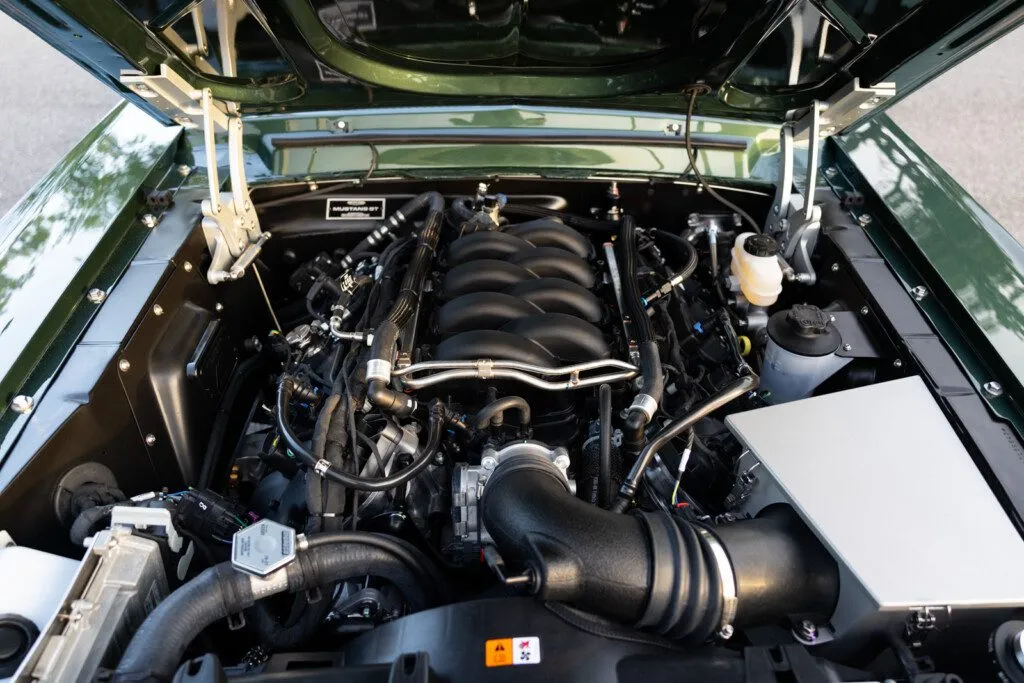
Does a Modern EFI Engine in a Newly-Built Reengineered Mustang Require Less Routine Maintenance?
A modern EFI engine in a newly-built reengineered Mustang does require less routine maintenance than a carbureted vintage powerplant. Electronic fuel injection eliminates carburetor cleaning, float adjustments, and fuel-air mixture tuning. There are no ignition points to replace, no distributor cap or rotor to inspect at regular intervals, and no ZDDP zinc supplementation required because modern engines use roller-follower camshaft designs rather than flat-tappet configurations. Oil change intervals are also extended compared to the 3,000-mile cycles recommended for conventional mineral-based oils in vintage engines. For enthusiasts who intend to drive regularly, EFI integration in a reproduction Mustang meaningfully reduces the frequency of hands-on mechanical intervention without compromising the classic aesthetic.
How Does Revology Cars’ Approach to Reengineered Mustangs Simplify Engine Upkeep?
Revology Cars’ approach to reengineered Mustangs simplifies engine upkeep by integrating contemporary Ford-sourced powertrains, fuel injection systems, and modern transmission technology into period-correct Mustang body structures assembled from new parts. According to Classic Motorsports Magazine, modern reproduction approaches like Revology’s reengineered Mustang combines modern reliability with classic aesthetics through contemporary engineering. Because Revology builds each car using new components rather than vintage parts, owners avoid the degradation issues common to aging rubber seals, original cork gaskets, and worn fuel system materials. The engines and transmissions are calibrated by Ford engineering teams, which means the powertrain arrives with validated performance baselines. For drivers who value reliability alongside classic style, this approach substantially reduces unplanned maintenance.
What Are the Key Takeaways About Classic Mustang Engine Maintenance We Covered?
The key takeaways about classic Mustang engine maintenance center on understanding what separates vintage engine care from modern practice, and how reproduction builds change that calculus. Original 1964.5-to-1973 engines require flat-tappet-specific oil with adequate ZDDP, regular carburetor service, points ignition upkeep, cooling system monitoring, and fuel management awareness of ethanol risks. Reproduction Mustangs with integrated EFI and modern drivetrains eliminate most of those vintage-specific tasks. Collectors focused on originality and those who prefer modern driveability have different maintenance realities, and neither path is wrong. The right maintenance approach depends entirely on what the car is, how it was built, and how you intend to use it.