
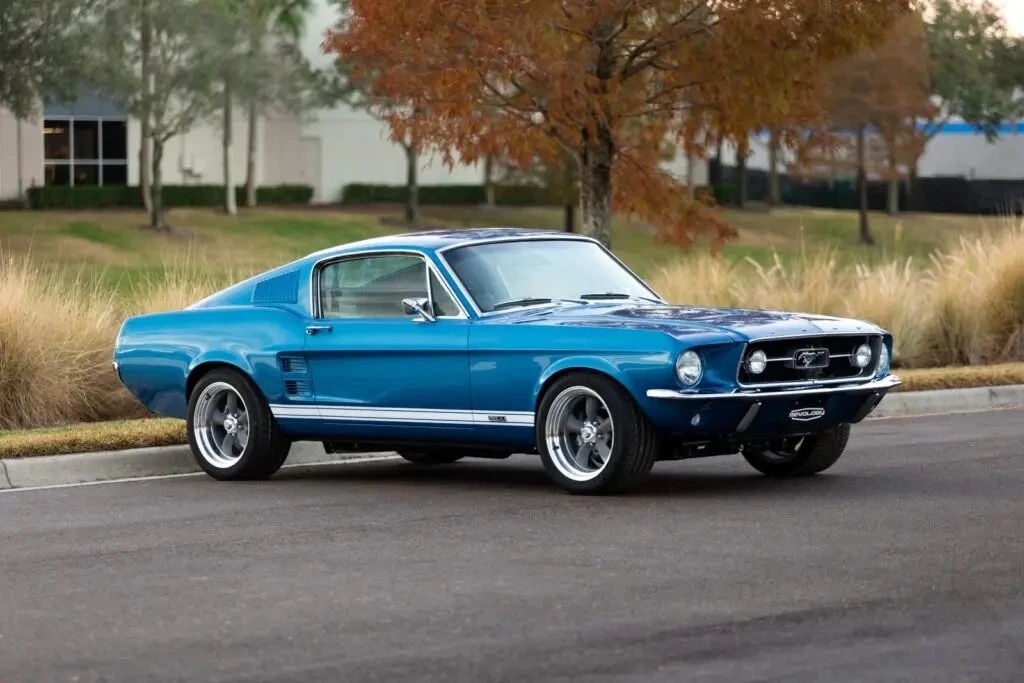
The Ford 302 cubic inch V8 is a small-block engine produced from 1968 through the mid-1970s, offered in the Mustang in multiple configurations ranging from a base two-barrel street variant to the race-homologated Boss 302.
This guide covers the 302’s core technical specifications, horsepower output by variant and year, how it compares to related Ford small-blocks, its carburetor and transmission pairings, how it shapes the classic Mustang driving experience, and how modern builds have reinterpreted models with the 302.
The 302’s specifications center on a 4.00-inch bore and 3.00-inch stroke, with compression ratios spanning 9.5:1 on the base engine to 10.5:1 on the Boss 302. Horsepower ranged from 210 hp on the two-barrel F-code to 290 hp on the 1969 Boss 302, before emissions regulations compressed output sharply after 1971.
Against the 289 and 351 Windsor, the 302 occupies a distinct position: it shares the 289’s block architecture while offering more displacement, and it stays physically smaller and lighter than the 351 Windsor despite sharing the same bore.
Carburetor and transmission choices directly shaped how each 302 Mustang drove, from the C4 automatic in base GT trims to the 780-cfm Holley on the Boss. The driving feel across variants reflects those differences: the standard 302 rewards more relaxed inputs, while the Boss 302 demands and rewards high-RPM commitment.
Modern builds, including Revology Cars’ new-construction Mustangs powered by the 460-horsepower Gen 4 Coyote V8, show how the 302 continues to inspire modern reproductions as a foundation for contemporary performance.
What Are the Core Specs of the Ford 302 Engine?
The core specs of the Ford 302 engine vary across variants, covering displacement, compression ratio, cylinder head design, and operational RPM. The sections below detail each specification category.
What Is the Displacement and Bore-Stroke Configuration of the 302?
The displacement and bore-stroke configuration of the 302 is 302 cubic inches (4.9 liters), with a bore of 4.00 inches and a stroke of 3.00 inches. This oversquare bore-to-stroke ratio gave the engine a balanced character: enough low-end torque for street driving and sufficient high-rpm potential for performance applications. The standard Windsor variant produced 210 hp with a 2-barrel carburetor, while the 4-barrel version climbed to 230 hp, according to CJ Pony Parts.
What Are the Compression Ratios Used Across 302 Variants?
The compression ratios used across 302 variants ranged from 9.5:1 on the base F-code two-barrel to 10.0:1 on the J-code four-barrel and 10.5:1 on the high-performance Boss 302. These ratios reflect the engine’s production span across different regulatory eras. The Clean Air Act of 1970 required a 90 percent reduction in automotive emissions by 1975, according to the EPA, which forced engineers to progressively lower compression ratios through the mid-1970s as a primary method for reducing NOx output. The detuning significantly blunted the 302’s performance character in its later production years.
What Are the Cylinder Head Specs on the Ford 302 Small-Block?
The cylinder head specs on the Ford 302 small-block varied by casting and production year, with chamber volume and valve sizing being the two most consequential differences. According to Engine Labs, the C8OE-F head used on 1968-1970 302 Windsor engines featured 53.5cc chambers with 1.78-inch intake and 1.45-inch exhaust valves. Most 1970s 302 heads expanded chamber size to 58cc while retaining the same 1.780/1.450-inch valve configuration, per DIY Ford. The Boss 302 departed from this entirely, using Cleveland-style cylinder heads with staggered and canted valve arrangements for superior airflow at high rpm.
What Is the Factory Redline and RPM Range of the 302?
The factory redline of the 302 engine typically fell between 5,200 and 6,000 RPM, depending on the specific variant. In practical terms, a stock 302 generates peak power between 4,600 and 4,800 RPM, meaning that performance-oriented drivers would typically shift in the 4,800–5,200 rpm range to keep the engine in its strongest power band after each gear change. The Boss 302 favored the upper end of this range, given its high-flow cylinder heads and race-derived architecture.
How Much Horsepower Does the Classic Mustang 302 Engine Produce?
The classic Mustang 302 engine produces horsepower figures that vary by variant, carburetor configuration, and model year. The sections below cover the two-barrel base engine, the four-barrel high-performance version, the Boss 302, and how output shifted into 1970.
How Much HP Did the 1968 Two-Barrel 302 Make?
The 1968 two-barrel 302 made 210 hp at 4,600 RPM and 300 lb-ft of torque at 2,800 RPM. This F-code engine used a 9.5:1 compression ratio with a 4.00-inch bore and 3.00-inch stroke. While modest by performance standards, it offered a practical balance of economy and power for everyday Mustang buyers who weren’t chasing the GT package.
How Much HP Did the 1968–1969 Four-Barrel High-Performance 302 Make?
The 1968 four-barrel high-performance 302 made 230 hp at 4,800 RPM and 310 lb-ft of torque at 2,800 RPM. This J-code engine ran a higher 10.0:1 compression ratio compared to the two-barrel variant. According to CJ Pony Parts, both versions shared the same 4.00 x 3.00-inch bore and stroke, with the four-barrel carburetor and elevated compression doing the real work of unlocking the extra output.
How Much HP Did the 1969 Boss 302 Engine Produce?
The 1969 Boss 302 engine produced 290 hp (SAE gross). Ford created this engine primarily to meet homologation requirements for the SCCA Trans-Am road racing series, which imposed a 305-cubic-inch displacement limit. According to Hemmings, the Boss 302 featured a 10.5:1 compression ratio, 2.23-inch intake valves, and a 780-cfm Holley carburetor on an aluminum dual-plane intake, making it the most purpose-built 302 variant offered in a street Mustang. Larry Shinoda, a former GM stylist at Ford, essentially named the car after the name stuck when he would respond that the secret project he was working on was “the boss’s car”.
How Much HP Did the 1970 302 Make Compared to Earlier Years?
The 1970 302 made essentially the same rated output as 1969 across its variants, though the Boss 302 received slightly revised intake valves measuring 2.19 inches rather than the 1969 spec of 2.23 inches. The standard two-barrel and four-barrel ratings held steady before emissions regulations began compressing output. By 1972, when U.S. automakers switched to SAE net ratings, the two-barrel 302 dropped to 140 hp at 4,000 RPM, making the pre-1972 gross figures look considerably stronger by comparison.
What Years Did Ford Put the 302 Engine in the Mustang?
The years Ford put the 302 engine in the Mustang span from 1968 through 1973, covering the final first-generation models and the full run of the second-generation Mustang II’s predecessor body style.
The 302 cubic inch V8 was first offered as an option in 1968. Ford continued offering the engine through 1969 and 1970, which also produced the celebrated Boss 302 variant. The engine carried into 1971, 1972, and 1973 before the Mustang line was significantly downsized.
Production numbers reflect the engine’s era: according to MustangSpecs.com, a total of 317,404 Mustangs were sold in 1968 across all body styles and engine configurations. By 1973, the final year of this body generation, production included 51,480 Coupes, 25,274 Grande Coupes, 11,853 Convertibles, and 10,820 Fastbacks combined across all powertrain options.
The 302’s initial six-year run before returning to the Mustang in 1979 makes it one of the most historically significant small-blocks in American muscle car history, appearing in both everyday GT trims and the racing-bred Boss 302.
What Is the Difference Between the 302 and Other Ford Small-Block Engines?
The difference between the 302 and other Ford small-block engines comes down to displacement, deck height, stroke, and intended purpose. The sections below compare the 302 against the 289, the 351 Windsor, and the high-performance Boss 302 variant.

How Does the 302 Compare to the Ford 289?
The 302 compares to the Ford 289 as a direct evolutionary successor sharing the same block architecture, bore spacing, and 4.00-inch bore. Ford achieved the additional displacement by lengthening the stroke from 2.87 inches (289) to 3.00 inches, keeping the engine physically interchangeable in most Mustang engine bays. Transmission compatibility carried over as well, since automatics and manuals originally mated to the 289 could generally be paired with the 302, often requiring only a bellhousing change. For most enthusiasts, the 302 represents a straightforward displacement gain over the 289 with minimal fitment trade-offs.
How Does the 302 Compare to the Ford 351 Windsor?
The 302 compares to the Ford 351 Windsor as a physically smaller engine with a shorter stroke and lower deck height. According to Summit Racing, the 351 Windsor block stands 1.300 inches taller than the 289/302, enabling a 3.50-inch stroke versus the 302’s 3.00-inch stroke. Both engines share the same 4.00-inch bore, but that taller deck height makes the 351 Windsor wider overall, requiring a larger intake manifold and taller distributor. Enthusiasts often favor the 351 Windsor for higher torque output and stroker-kit potential, while the 302 remains the lighter, more chassis-friendly option for Mustang applications.
How Does the Boss 302 Differ from the Standard 302?
The Boss 302 differs from the standard 302 primarily through its cylinder heads, internal components, and racing purpose. Ford built the Boss 302 to meet SCCA Trans-Am homologation requirements, which imposed a 305-cubic-inch (5.0 liter) displacement limit. In place of standard Windsor heads, the Boss 302 used Cleveland-style cylinder heads with canted, staggered valves; a high-nickel-content iron block with four-bolt main caps; and forged pistons. According to Hemmings, the 1969 Boss 302 featured 2.23-inch intake valves and a 10.5:1 compression ratio, well above the standard 302’s configuration. The Boss 302 Mustang went on to win the Trans-Am championship in 1970, validating that engineering investment on the race track.
What Carburetor and Induction Options Came on the Mustang 302?
The Mustang 302 used different carburetor and induction setups depending on the variant. The base 302 relied on a simpler two or four-barrel configuration, while the Boss 302 received a purpose-built high-performance induction system designed for racing.
What Carburetor Did the Base 302 Use?
The base 302 used either a two-barrel or four-barrel carburetor, depending on the performance level. According to CJ Pony Parts, the F-code 302 came with a two-barrel carburetor producing 210 hp at 4,600 RPM, while the J-code 302 used a four-barrel carburetor and produced 230 hp at 4,800 RPM. The four-barrel setup also improved torque output to 310 lb-ft at 2,800 RPM. For most buyers, the two-barrel was the everyday-driver choice; the four-barrel suited those who wanted more performance from the same displacement.
What Induction Setup Did the Boss 302 Use?
The Boss 302 induction setup used a 780-cfm Holley carburetor mounted on an aluminum dual-plane intake manifold. According to Hemmings, this combination fed the high-flowing Cleveland-style cylinder heads that gave the Boss 302 its exceptional breathing capability at high RPM. The aluminum intake reduced weight while supporting the engine’s race-oriented powerband. This setup reflected the Boss 302’s Trans-Am competition origins and remains one of the most distinctive factory induction systems ever fitted to a production Mustang.
What Transmission Options Were Paired with the Mustang 302?
The transmission options paired with the Mustang 302 included both automatic and manual gearboxes, giving buyers meaningful choices to match their driving style. The sections below cover the specific automatic units available and the manual options that could be mated to the 302.
What Automatic Transmissions Were Available with the 302?
The automatic transmissions available with the 302 were the C4 and the FMX. The C4 was the standard automatic in most 302 applications, while the FMX served as a heavier-duty alternative. According to Automobile-Catalog.com, the 1969 Mustang Sportsroof equipped with a 302 V-8 and Cruise-O-Matic transmission was rated at 220 hp (SAE gross) and 300 ft-lb of torque. For most street-driven 302 Mustangs, the C4 was the more common pairing, though buyers seeking added durability could opt for the FMX. For the Boss 302, no factory automatic option was available.
What Manual Transmissions Could Be Paired with the 302?
The manual transmissions paired with the 302 were largely carried over from earlier small-block applications. 3-speed manual or 4-speed Toploader manual configurations were the primary options available. According to Vintage-Mustang.com, any automatic or manual transmission originally installed behind a 260 or 289 engine could generally be mated to a 302, often requiring only a bellhousing change. This broad compatibility made the 302 a flexible foundation for both factory builds and later owner modifications.
How Does the 302 Engine Affect Classic Mustang Performance and Driving Feel?
The 302 engine shapes classic Mustang performance through its power delivery characteristics, driving dynamics, and the distinct sensory experience it produces behind the wheel. The sections below cover how the standard 302 drives on the street, how the Boss 302 transforms the handling equation, and how emissions regulations changed the engine’s real-world feel over time.

How Does the Standard 302 Feel to Drive in a Classic Mustang?
The standard 302 delivers a driving feel defined by accessible torque, a willing rev character, and the unmistakable sound of a small-block V8. The F-code two-barrel variant produced 300 lb-ft of torque at 2,800 RPM according to CJ Pony Parts, meaning strong pull arrives early in the rev range. Shifting is most effective between 4,800 and 5,200 RPM, where the engine approaches its power peak before tapering off. For street driving, this translates to a car that feels responsive without requiring high-strung maintenance of the throttle. The 302 rewards relaxed inputs and suits both cruising and spirited acceleration, making it a well-rounded choice for enthusiasts who drive their classic Mustangs regularly.
How Does the Boss 302 Change the Driving Dynamics of the Mustang?
The Boss 302 changes Mustang driving dynamics significantly through a high-revving, race-derived engine paired with purpose-built chassis tuning. Car and Driver described the Boss 302 as “unshakable,” noting that maneuvers unsettling in other Mustangs felt recreational in the Boss. Chassis development was led by ride and handling engineer Mat Donner, whose work gave the Boss 302 a composure beyond standard Mustang handling of the time. The engine itself, breathing through a 780-cfm Holley carburetor on an aluminum dual-plane intake, favored upper-RPM power delivery rather than the lower-end torque character of the standard 302. For enthusiasts who want the most engaged, performance-oriented driving experience from a 302-powered Mustang, the Boss variant represents the highest expression of what that engine platform could achieve.
How Did Emissions Regulations Change the 302’s Performance Feel Over Time?
Emissions regulations progressively dulled the 302’s performance feel through mandatory reductions in compression ratio and output. The Clean Air Act of 1970 required a 90 percent reduction in emissions from new automobiles by 1975, and lowering compression ratios became one of the primary engineering responses to meet NOx targets. By 1972, when U.S. automakers switched to SAE net horsepower ratings, the 302 two-barrel dropped to 140 hp at 4,000 RPM, per CJ Pony Parts. The result was a noticeably softer engine with less throttle response and reduced high-RPM enthusiasm compared to the 1968-1969 variants. Collectors and drivers who want the sharpest 302 driving experience typically target pre-1972 examples for this reason.
With driving feel established across the 302’s production run, the natural next question is how modern builds recreate or surpass that experience in a classic Mustang body.
How Have Modern Builds Reimagined the Classic Mustang 302 Experience?
Modern builds have reimagined the classic Mustang 302 experience by pairing period-correct bodywork with contemporary Ford powertrains. The sections below compare original and modern powertrains, examine Revology Cars’ manufacturing approach, and summarize the key takeaways from this guide.
How Do Modern Ford Powertrains Compare to the Original 302 in a Classic Mustang Body?
Modern Ford powertrains compare to the original 302 by delivering significantly more power within the same classic Mustang proportions. The original 1968 302 Windsor produced 230 hp at 4,800 RPM, while the Gen 4 Ford 5.0L Coyote V8 produces around 480 horsepower in stock form. That is double the output from an engine that fits the same engine bay. Beyond raw numbers, the modern Coyote engine offers fuel injection, modern emissions compliance, and improved reliability. For enthusiasts who prioritize driveability over simply preserving a numbers-matching original classic Mustang, the powertrain gap between 1968 and today is substantial and practically relevant.
Can a Revology Cars Mustang Deliver Classic 302 Style with Modern Performance?
Yes, a Revology Cars newly-built Mustang can deliver classic 302 style with modern performance. Revology Cars builds new-construction classic Mustangs, including a reengineered 1970 Boss 302 reproduction, powered by a modern Ford 5.0L Coyote V8 engine producing 460 horsepower, while honoring the original 302-era styling. These are not modified original vehicles; Revology assembles its body structures from new parts. For buyers who want the visual and emotional experience of a classic Mustang without the trade-offs of a 55-year-old drivetrain, this approach offers a distinctive path.

What Are the Key Takeaways About the Classic Mustang 302 Engine We Covered?
The key takeaways about the classic Mustang 302 engine are centered on its range, evolution, and enduring relevance. The 302 cubic inch V8 was first offered as a Mustang option in 1968 and remained in production through the mid-1970s. Core lessons from this guide include:
- The standard 302 produced between 210 and 230 hp depending on carburetor configuration.
- The Boss 302 was purpose-built for SCCA Trans-Am racing, with Cleveland-style heads offering better airflow and a 10.5:1 compression ratio.
- Emissions regulations drove compression ratios and output down sharply after 1971.
- Rebuilding a 302 today carries real cost, potentially around $6,300 to $9,780 for a basic stock rebuild.
- Modern builds like those from Revology Cars honor 302-era styling while offering twice the horsepower and increased reliability through the Coyote V8.
Whether you value originality, performance, or both, the 302’s legacy shapes every decision in the classic Mustang space.