
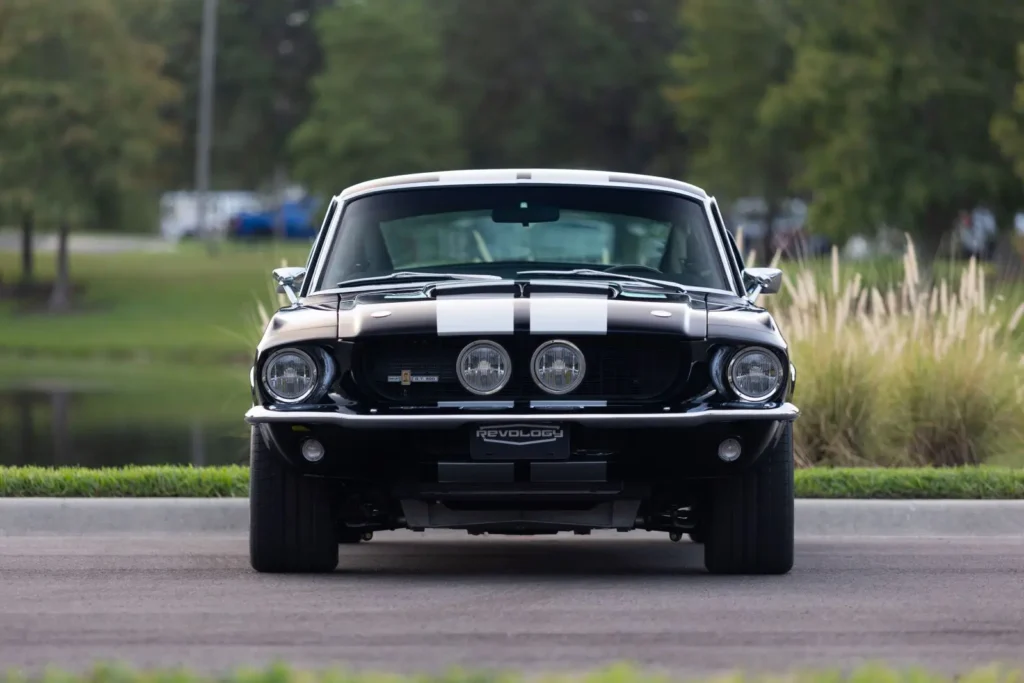
The final production years of the Shelby GT350 and GT500 are two modern distinct performance philosophies built on the same Mustang platform: the GT350 is a high-revving, naturally aspirated road course tool optimized for driver feel, while the GT500 is a supercharged straight-line weapon with enough track capability to back up its power figures.
This guide covers engine architecture and power delivery, track and road behavior, straight-line acceleration, transmission character, steering and handling feedback, pricing and collector value, cockpit and technology differences, driver-fit recommendations, and how Revology’s classic reengineered Mustangs connect to the broader Shelby legacy.
The final generation (2015–2020) GT350’s 5.2L Voodoo V8 produces around 526 horsepower at a flat-plane-enabled 8,250 rpm redline, while the final generation (2020–2022) GT500’s supercharged Predator V8 generates 760 horsepower with relentless, boost-driven acceleration across the rev range. Those numbers set the tone for everything that follows.
On the track and public road, each car pursues grip and control through different means: the GT350 prioritizes chassis balance and tactile feedback, while the GT500 leans on mechanical grip, mass management, and braking hardware including 16.5-inch front rotors.
Transmission choice separates them further. The GT350 pairs exclusively with a Tremec 6-speed manual; the GT500 uses a 7-speed dual-clutch automatic with lightning-fast, torque-managed shift behavior optimized for high-output performance.
Pricing, resale trends, and collector auction results reveal which model holds long-term value, and the driver-fit section maps each car to four distinct enthusiast profiles so buyers can match the right Shelby to their actual priorities.
How Do the GT350 and GT500 Differ in Engine and Power?
The GT350 and GT500 differ in engine and power through fundamentally different approaches: the GT350 uses a naturally aspirated flat-plane V8 built for high-revving precision, while the GT500 uses a supercharged V8 tuned for maximum force. The sections below cover output figures, engine architecture, and power delivery character for each model.
How Much Power Does the Shelby GT350 Produce?
The 2015-2020 Shelby GT350 produces 526 horsepower at 7,500 rpm and 429 lb-ft of torque at 4,750 rpm from its 5.2L Voodoo V8. By comparison, the GT500’s supercharged 5.2L Predator V8 generates 760 horsepower and 625 lb-ft of torque. The Voodoo’s 12.0:1 compression ratio reflects its naturally aspirated design, optimized for throttle response and sustained track performance rather than forced-induction peak torque delivery.
How Much Power Does the Shelby GT500 Produce?
The modern Shelby GT500 produces 760 horsepower and 625 lb-ft of torque from its supercharged 5.2L Predator V8. According to CJ Pony Parts, the 2020 GT500 reaches 60 mph in 3.3 seconds and completes the quarter-mile in 10.7 seconds at over 130 mph. The GT500 equipped with the Carbon Fiber Track Pack also generates around 1.16 g of lateral acceleration, demonstrating that its power extends well beyond straight-line dominance. The GT500’s 5.2L Predator V8 uses a 9.5:1 compression ratio, a configuration typical of forced-induction engines to improve knock resistance and support high boost levels safely.
Which Engine Layout Gives the GT350 Its High-Revving Character?
The GT350’s high-revving character comes from its flat-plane crankshaft, which reduces rotating mass and allows the engine to spin freely to an 8,250 rpm redline. The flat-plane layout also produces a distinctive exhaust note that many enthusiasts consider part of the GT350’s identity. Supporting this architecture, the GT350’s Tremec TR-3160 transmission is rated for 582 Nm of input torque and incorporates a high-capacity clutch purpose-built for the Voodoo’s operating range. In comparison, the cross-plane crankshaft used in the GT500’s Predator V8 produces more low-end torque, but limits peak rpm.
How Does the GT500’s Supercharger Change the Power Delivery?
The GT500’s supercharger changes power delivery by building boost pressure continuously across the rpm range, eliminating the narrow power band typical of high-revving naturally aspirated engines. MotorTrend’s Chris Walton describes the result as “explosively powerful” with no discernible peaks or valleys, making it easy to run the engine against the rev limiter without hunting for a specific power window. Where the GT350 rewards drivers who explore the upper reaches of the rev range, the GT500 delivers immediate, torque-rich performance across the powerband, making it easier to access its speed potential in a wider variety of driving conditions.
How Do the GT350 and GT500 Compare on the Track?
On the track, the GT350 and GT500 pursue performance through fundamentally different philosophies: the GT350 prioritizes balance and driver feedback, while the GT500 delivers raw grip and brute force. The sections below cover lap times, cornering behavior, braking, and weight distribution.
Which Car Posts Faster Lap Times at Road Courses?
Lap times at road courses favor the GT500 when properly equipped. A Shelby GT350R recorded a verified lap of 1:38.733 at Road Atlanta on July 8, 2021. The 2020 Shelby GT500 equipped with the Carbon Fiber Track Pack achieved a personal best of 2:21.098 at Circuit of the Americas, a longer and more technically demanding circuit, making direct comparison difficult without normalized data. Circuit layout, driver skill, and configuration all influence which car holds the advantage on any given track.
How Does Each Car Handle High-Speed Cornering?
Each car handles high-speed cornering through a distinct performance character. The GT500 with the Carbon Fiber Track Pack generates a lateral acceleration of 1.16 g, reflecting substantial mechanical grip from its wider tires and aggressive suspension tuning. The GT350R, described by MotorWeek as “light, balanced, and incredibly responsive,” favors chassis agility and mid-corner adjustability over peak lateral load. For drivers who value feel and precision over raw numbers, the GT350R’s cornering behavior is arguably the more rewarding experience.
Which Model Brakes More Effectively Under Race Conditions?
The GT500 brakes typically more effectively under race conditions, aided by 16.5-inch front rotors that provide substantial thermal capacity and stopping force during repeated hard stops. The GT350’s lighter curb weight partially compensates, reducing the kinetic energy the brakes must absorb. Under sustained track use, the GT500’s larger rotor surface area offers a meaningful advantage in heat management and consistent brake pedal feel.
How Does Weight Distribution Affect Track Performance in Each?
Weight distribution affects track performance in each car through its influence on balance, turn-in response, and mid-corner stability. The GT350’s lighter overall mass and naturally aspirated powertrain place slightly less weight over the front axle, though the GT350 would still be considered a front-heavy but well-tuned vehicle. The GT500’s supercharged engine and broader chassis add mass, which the suspension and tire package must manage. For precision road course work, lighter weight distribution can give the GT350 a measurable handling edge over the slightly heavier GT500.
How Do the Modern GT350 and GT500 Feel to Drive on Public Roads?
On public roads, the newest generation of the GT350 and GT500 deliver different experiences shaped by their powertrains, transmissions, and suspension tuning. The sections below cover daily drivability, highway behavior, control at legal speeds, and ride comfort.
How Does the Modern GT350 Handle Daily Driving Conditions?
The modern GT350 handles daily driving conditions with surprising composure, though it demands more driver involvement than a standard Mustang. The Voodoo V8 is genuinely tractable at low revs, but the transmission requires deliberate clutch work in stop-and-go traffic. MotorWeek describes the GT350R as “light, balanced, and incredibly responsive,” a character that translates to an engaging, connected feel even on surface streets. The Recaro seats, with aggressive thigh bolster support, keep the driver firmly planted during dynamic maneuvers. Fuel economy of 14 mpg city and 21 mpg highway is the tradeoff for that mechanical intensity.
How Does the Modern GT500 Behave on Open Highways?
The modern GT500 behaves on open highways like a refined grand tourer with explosive reserves. According to MotorTrend’s Chris Walton, the Predator V8’s power delivery is linear with no discernible peaks or valleys, making it deceptively easy to manage at cruising speeds. The DCT shifts smoothly during relaxed driving, requiring no manual input. At legal speeds, 760 horsepower stays largely dormant, leaving the driver with a surprisingly planted, stable feel. The tradeoff is 12 mpg city and 18 mpg highway.
Which Car Is Easier to Control at Legal Speeds?
The GT500 is easier to control at legal speeds for most drivers. Its dual-clutch transmission removes the need for clutch and shift coordination, while its supercharged V8 delivers strong, repeatable acceleration with minimal driver input. The GT350, while not unruly, demands active engagement through its manual gearbox and high-revving engine. For drivers who want confidence without constant mechanical management, the GT500 offers a lower-effort driving experience in everyday conditions.
How Do Their Suspension Setups Affect Ride Comfort?
Both cars use MagneRide damper systems, but each is tuned for a distinct purpose. The GT350’s suspension prioritizes high-g cornering balance, producing a firmer, more communicative ride that transmits road texture clearly to the driver. The GT500’s setup manages considerably more mass and power, so it leans toward composed stability over raw feedback. On rough pavement, neither car’s design priority is focused on comfort, but the GT500’s suspension tuning and chassis mass give it slightly greater compliance over everyday road imperfections. The GT350 rewards drivers who want to feel the road; the GT500 is better suited to those who prefer high performance with greater stability and less chassis disturbance at speed.
How Do the GT350 and GT500 Compare in Straight-Line Speed?
The GT500 wins decisively in straight-line speed, with the GT350 trailing in both 0-60 times and quarter-mile performance. The sections below cover each model’s acceleration figure and drag race outcome.
What Is the 0–60 Time of the Shelby GT350?
The 0-60 time of the Shelby GT350 is 3.9 seconds, with a quarter-mile time of 12.2 seconds. Those figures reflect a naturally aspirated engine that rewards mechanical precision over brute force. The GT350R’s verified lap time of 1:38.733 at Road Atlanta in 2021 confirms that its performance strengths lie on the road course, not the drag strip.
What Is the 0–60 Time of the Shelby GT500?
The 0-60 time of the Shelby GT500 is 3.3 seconds, with a quarter-mile completed in 10.7 seconds at over 130 mph. The Carbon Fiber Track Pack variant also achieved a personal best lap of 2:21.098 at Circuit of the Americas, demonstrating that while the GT500 generally holds its advantage in straight-line power, its capabilities can extend into track performance as well.
Which Model Wins in a Quarter-Mile Drag Race?
The GT500 wins a quarter-mile drag race over the GT350 by a significant margin. Its trap speed exceeds 130 mph, compared to the GT350’s recorded 119.6 mph. The GT500’s Tremec TR-9070 7-speed dual-clutch automatic uses torque-managed shift logic to maintain near-continuous acceleration between gears, a mechanical advantage that the GT350’s 6-speed manual does not replicate off the line, and with driver skill also factoring into performance with manual gearboxes.
How Do Transmission Options Differ Between the Modern GT350 and GT500?
The GT350 and GT500 use fundamentally different transmission technologies. The sections below cover the GT350’s manual gearbox, the GT500’s dual-clutch automatic, and how each choice shapes the driving experience.
Does the GT350 Offer a Manual Gearbox Option?
Yes, the GT350 offers a manual gearbox option — and it is the only option available. The GT350 is equipped exclusively with a Tremec TR-3160 6-speed manual transmission. According to Tremec, this unit is rated for 582 Nm (429 lb-ft) of input torque and features a high-capacity clutch specifically engineered to handle the Voodoo engine’s high-revving demands. For drivers who value mechanical connection over automated efficiency, the GT350’s manual transmission strategy is a deliberate design philosophy.
What Transmission Does the GT500 Use?
The GT500 uses a Tremec TR-9070 7-speed dual-clutch automatic (DCT). Unlike a traditional torque-converter automatic, this DCT is engineered for performance-first operation. It employs torque-managed shift logic to transition from gear to gear in as quickly as 80 milliseconds without interrupting torque, exploiting engine inertia to produce faster elapsed times at the dragstrip. No manual transmission option is available on the GT500.
How Does Each Transmission Affect the Driving Experience?
Each transmission affects the driving experience in distinctly different ways. The GT350’s Tremec 6-speed manual places full control in the driver’s hands, rewarding precision inputs and delivering tactile feedback that enthusiasts associate with authentic sports car engagement. The GT500’s DCT prioritizes outright speed, executing shifts faster than can be managed by people. The choice ultimately reflects two different driving philosophies: one built around driver involvement, the other around mechanical optimization for performance.
How Do the GT350 and GT500 Compare in Steering and Handling Feedback?
Steering and handling feedback differ significantly between these two Shelby models. The GT350 prioritizes driver communication and tactile feel, while the GT500 emphasizes grip and composure at high cornering loads.
Which Car Delivers More Communicative Steering Feel?
The modern GT350 delivers, more communicative steering feel than the GT500. Its naturally aspirated Voodoo V8, flat-plane crankshaft, and manual transmission combine to create a direct, unfiltered connection between driver and road. The GT500, by contrast, prioritizes stability and planted confidence at speed, utilizing an automatic transmission which softens the immediate feedback loop most enthusiast drivers seek. For drivers who want to feel every road input translate through the wheel, the GT350 arguably offers a more engaging experience.
How Does Tire Width Affect Handling Responsiveness in Each?
Tire width affects handling responsiveness in each model by shaping how quickly the car reacts to steering inputs. The GT350 uses narrower front tires relative to the GT500 with the Carbon Fiber Track Pack, which prioritizes turn-in quickness and nimble transitions over maximum grip. The GT500 CFTP generates 1.16 g of lateral acceleration, a figure enabled in part by its wider contact patches. Wider tires increase cornering grip but can reduce the sharpness of initial steering response, creating a slightly more planted, less darty feel. For pure responsiveness, narrower front tires generally favor the GT350’s handling character.
Which Model Is Better Suited for Enthusiast Drivers Who Prioritize Feel?
The GT350 is better suited for enthusiast drivers who prioritize feel over outright performance numbers. Its manual transmission, high-revving Voodoo engine, and lighter, more reactive chassis reward drivers who want to be deeply involved in every aspect of the driving experience. The GT500 is a remarkably capable machine, but its dual-clutch transmission and high downforce setup shift the experience toward managed performance rather than raw sensory feedback. For drivers who measure satisfaction in communication rather than lap times, the GT350 is a rewarding experience.
How Do the GT350 and GT500 Differ in Price and Value?
The GT350 and GT500 differ in price and value across original MSRP, resale stability, and collector appeal. The sections below cover each model’s starting cost, how used market values compare, and which car makes the stronger long-term investment.
What Was the Original MSRP of Each Shelby Model?
The original MSRP of each Shelby model placed the 2020 GT350 at around $60,440 and the GT500 at around $72,900, a gap of roughly $12,500. Buyers who optioned the GT500 with the Carbon Fiber Track Pack saw the price climb to $91,500, making it a substantially larger commitment than even a fully loaded GT350.
Which Modern Model Holds Its Resale Value Better Over Time?
Resale value trends favor the GT350 for buyers who prioritize price stability relative to original cost. According to a 2021 report by Hagerty, used GT350 models had largely stabilized near their original insured values, showing minimal depreciation at that point in the market cycle. That kind of retention, on a car that originally started under $61,000, reflects genuine demand from driving enthusiasts rather than just collector speculation.
Is the GT350 or GT500 a Better Investment for Collectors?
The GT350 or GT500 investment case depends heavily on the buyer’s intent. The GT500, particularly limited editions, has demonstrated strong auction performance; a 2022 GT500 Heritage Edition sold for $145,000 at Mecum with just 17 miles recorded. Meanwhile, a 1965 GT350 recently crossed $400,000 in the collector market, illustrating the ceiling that time and rarity can create. Both models reward patient ownership, but low-mileage GT500 variants appear to carry more near-term upside for buyers focused on short-horizon appreciation.
How Do the GT350 and GT500 Compare in Interior and Driver-Focused Features?
The GT350 and GT500 share the same Ford Mustang shell but diverge sharply in cabin philosophy. The sections below cover standard technology and driver aids, then cockpit and seating differences.

What Technology and Driver Aids Come Standard in Each?
The technology and driver aids that come standard in each model reflect their distinct performance priorities. Both cars include Ford’s SYNC infotainment system, launch control, line-lock, and selectable drive modes (Normal, Sport, Track). The GT500 adds a more sophisticated electronic damping system and a dedicated drag-strip mode through its DCT, while the GT350 leans on mechanical simplicity, pairing its analog-focused instrument cluster with a flat-plane Voodoo engine that revs to 8,250 rpm. That high redline is itself a driver aid of sorts: it extends the power band long enough to reward precise manual gearbox inputs.
How Do Cockpit and Seating Differences Affect the Experience?
Cockpit and seating differences affect the experience by shaping how physically connected the driver feels to the car during aggressive driving. According to Mustang6G’s comparison of GT and GT350 Recaro seats, the GT350’s Recaro design uses more aggressive thigh bolster support than standard Mustang GT seats, locking the driver’s lower body firmly in place during high-g cornering. The GT500’s standard seats are supportive but tuned for broader comfort, reflecting its dual role as a road car capable of serious track work, while Recaro sport seats were available as an optional upgrade for more aggressive driving use. For drivers who treat corner-exit body movement as feedback, the GT350’s Recaro bolsters make a measurable difference in confidence. Understanding each car’s cockpit character helps clarify which Shelby matches a given driver’s style.
Which Shelby Is Right for Your Driving Style?
The right Shelby depends entirely on what you want from the car. The sections below break down how each model fits four distinct driver profiles: handling-first enthusiasts, straight-line performance seekers, weekend track drivers, and all-around street and strip buyers.
Is the GT350 Better for Drivers Who Prioritize Handling Over Power?
The GT350 may be preferable for drivers who prioritize handling over power, offering a naturally aspirated 5.2L Voodoo V8 with a 8,250 rpm redline tuned to reward mechanical precision over brute force. Described as “light, balanced, and incredibly responsive,” MotorWeek’s characterization of the GT350R highlights its focus on agility and precision in cornering. The Recaro seats add aggressive thigh bolster support to keep the driver planted during high-g cornering. For enthusiasts who genuinely want to feel the road communicate through every input, the GT350’s high-revving character is difficult to match.
Is the GT500 Better for Drivers Who Want Maximum Straight-Line Force?
The GT500 is better for drivers who want maximum straight-line force, producing 760 horsepower and 625 lb-ft of torque through a supercharged 5.2L Predator V8. According to MotorTrend, the GT500’s power delivery is linear with no discernible peaks or valleys, making it “explosively powerful” and effortless at the rev limiter. The Tremec TR-9070 7-speed DCT shifting maintains wide-open throttle during gear changes, further optimizing straight-line elapsed times. If your priority is relentless acceleration above all else, the GT500 is a winner.
Which Shelby Suits Weekend Track Enthusiasts Most?
Weekend track enthusiasts may be suited to the GT350, particularly the GT350R variant, which posted a verified lap of 1:38.733 at Road Atlanta. Its naturally aspirated engine, manual transmission, and balanced chassis create a feedback-rich environment that rewards consistent driver development over multiple sessions. That said, the GT500 with the Carbon Fiber Track Pack is no passenger: it generates 1.16 g of lateral acceleration and posted a 2:21.098 lap at COTA. Drivers seeking pure input feel may favor the GT350, while those wanting maximum machinery at a well-organized track day may find the GT500 CFTP equally capable.
Which Shelby Is the Better All-Around Street and Strip Package?
The better all-around street and strip package is arguably the GT500, which combines 3.3-second 0-60 performance and a 10.7-second quarter-mile with enough technology to remain manageable on public roads. The GT350 holds its own as a streetcar with ever so slightly better fuel efficiency (14 mpg city, 21 mpg highway versus the GT500’s 12/18) and a manual gearbox that rewards daily engagement. Choosing between them ultimately comes down to priorities: the GT350 excels as a driver’s car you build a relationship with, while the GT500 delivers an event every time you press the accelerator. Neither is the wrong answer; they serve genuinely different ambitions.
How Do Revology’s Reengineered Classic Mustangs Relate to the Shelby Legacy?
Revology Cars produces brand new, reengineered 1967–1970 Mustangs and officially-licensed 1967-1968 Shelby GTs, blending classic aesthetics with modern performance components. The sections below cover how a Revology build delivers a contemporary driving experience within vintage Shelby-era style, and the key takeaways from the GT350 vs. GT500 showdown.

Can a Revology Mustang Reengineered Restoration Deliver a Modern Driving Experience With Vintage Shelby-Era Style?
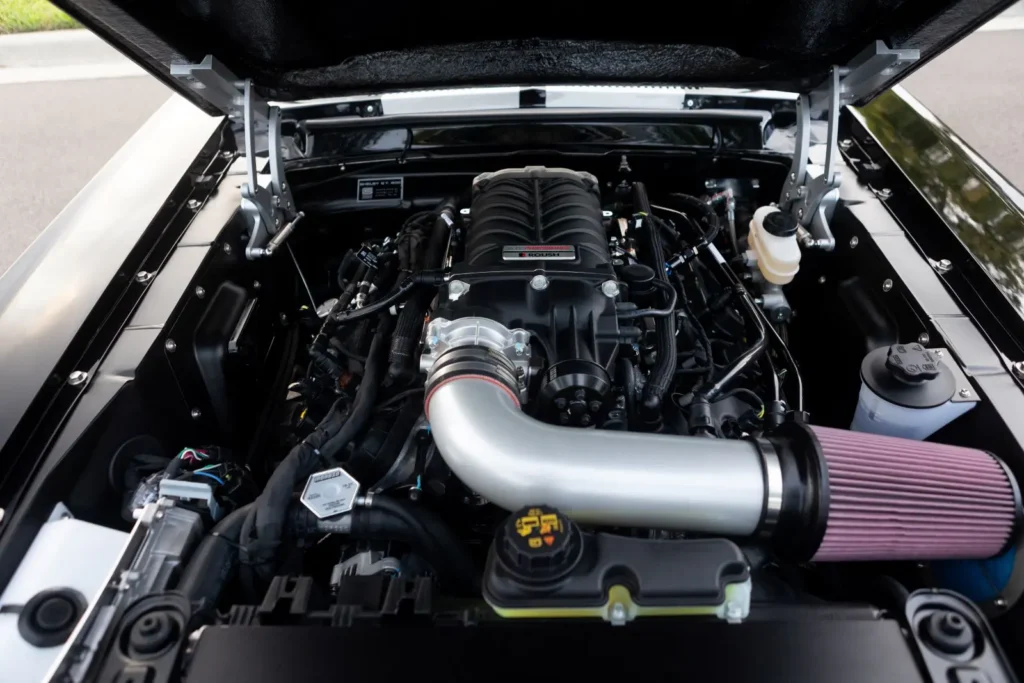
Yes, a Revology Mustang reengineered restoration can deliver a modern driving experience within vintage Shelby-era style. Revology Cars builds brand new, reengineered 1967–1970 Mustangs and officially-licensed 1967-1968 Shelby GTs, integrating current powertrain and chassis technology into period-correct bodywork. The result preserves the visual identity that defined the original Shelby era while offering the reliability and refinement that today’s enthusiasts expect from daily driving.
For enthusiasts who want to drive regularly without sacrificing the aesthetic that made 1960s Shelby Mustangs iconic, a Revology restoration offers that balance, though collectors focused on unmodified originality will rightly see that as a separate pursuit.
What Are the Key Takeaways From the Modern GT350 vs GT500 Driving Experience Showdown?
The key takeaways from the modern GT350 vs. GT500 driving experience showdown are that each car serves a different kind of enthusiast. The GT350 rewards drivers who prize high-revving naturally aspirated power, a manual transmission, and balanced road-course handling. The GT500 prioritizes straight-line dominance, with 760 horsepower and a 7-speed DCT delivering 0–60 in 3.3 seconds.
Neither is the universal “better” choice. The right model depends on whether the buyer values tactile engagement and feedback or maximum mechanical force. Revology’s classic Mustang builds occupy a distinct space in this conversation, offering a path to Shelby-lineage style for enthusiasts whose ideal experience centers on the look and character of the 1960s originals with modern performance engineering.