

The Mustang Boss 302 and Shelby GT350 are both track-focused, high-performance variants of the Ford Mustang, each built around a high-revving naturally aspirated V8 and purpose-driven chassis tuning. Where they diverge is in engineering philosophy, outright capability, and the kind of driver experience they deliver.
This guide covers both cars’ origins and identities, modern engine architecture and power output, track and straight-line performance, sound and driver engagement, chassis dynamics including weight and aerodynamics, braking and transmission hardware, daily usability versus track suitability, and long-term collectibility and value.
The modern Boss 302 and modern GT350 each carry distinct mechanical identities rooted in their V8s: the Boss uses a cross-plane 5.0L performance variant of the Coyote engine nicknamed the “Road Runner”, introduced in 2012 and producing 444 horsepower. In comparison, the GT350’s flat-plane 5.2L “Voodoo” was introduced in 2015, producing 526 horsepower and a sharply different acoustic and throttle character.
On circuit, the data favors the GT350: its MagneRide suspension, larger Brembo brakes, and aerodynamic downforce combine to produce lap times measurably faster than the Boss 302. The Boss 302 answers with mechanical adjustability, the optional TracKey calibration, and a more linear powerband that many drivers find easier to exploit consistently on the street and track.
Both cars have appreciated above their original MSRPs, with limited-edition variants, particularly the Boss 302 Laguna Seca and GT350R, commanding the strongest collector premiums. We also cover how Revology Cars extends the Boss 302 and GT350 legacies through a modern reproduction built on the original 1970 body style for the Boss 302, and various model years for the GT350.
What Is the Mustang Boss 302?
The Mustang Boss 302 is a track-focused, high-performance variant of the Ford Mustang, produced in two distinct eras: the original 1969–1970 models and the modern 2012–2013 revival. Both generations share a racing-bred identity built around a high-revving V8, a close-ratio manual transmission, and suspension tuning that prioritizes corner speed over comfort. The sections below cover the modern Boss 302’s engine, handling credentials, and signature TracKey system.
What Is the Shelby GT350?
The Shelby GT350 is a track-focused, high-performance variant of the Ford Mustang produced in two distinct eras: the original 1965–1970 models and the modern 2015–2020 generation. Built on the sixth-generation S550 Mustang platform, the modern GT350 represents Ford Performance’s most driver-focused naturally aspirated production Mustang of its era, designed to deliver track-capable handling and an extraordinary engine experience.
How Do the Modern Boss 302 and GT350 Engines Compare?
The modern Boss 302 and GT350 share a similar power peak around 7500 rpm but differ slightly in displacement, crankshaft design, and character. The sections below break down street performance, the Voodoo’s flat-plane architecture, and which engine delivers more usable power at the top of the rev range.
How Does the Boss 302’s 5.0L V8 Perform on the Street?
The Boss 302’s 5.0L Coyote V8 produces 444 horsepower at 7500 rpm and 380 lb-ft of torque at 4500 rpm, giving it a broad, accessible power band that rewards both street and canyon driving. Its new intake manifold with velocity-stack-style runners and CNC-massaged cylinder heads push every rev to feel purposeful. John Phillips of Car and Driver described the V8 as “so vigorous and charismatic that its likeness ought to be carved on Mount Rushmore” — a hard sentiment to argue with once you’ve heard it pull to redline.
How Does the GT350’s Flat-Plane Crank 5.2L V8 Change the Experience?
The GT350’s 5.2L “Voodoo” V8 changes the experience through its flat-plane crankshaft, which allows faster exhaust scavenging and a higher-revving character more typical of European sports cars than American muscle. According to SAE International, the Voodoo uses a linerless aluminum cylinder block finished with PTWA (Plasma Transfer Wire Arc) technology, reducing internal friction. The result: 526 horsepower and 429 lb-ft of torque at the same 7500 rpm ceiling, but with a distinctly sharper, more urgent throttle response throughout the rev range.
Which Engine Produces More Usable Power at High RPM?
The GT350 produces more usable power at high RPM, with an 82-horsepower advantage over the Boss 302’s Coyote engine. Both engines peak at 7500 rpm, but the Voodoo’s flat-plane architecture keeps the power delivery linear and aggressive as revs climb. The Boss 302’s redline sits around 7,500 rpm, while the GT350’s redline sits between around 8,200 and 8,300 rpm.
The Boss 302’s TracKey system partially closes the gap on track by delivering increased low-end torque, stronger engine braking, and more aggressive throttle response — making it a more versatile tool across a wider range of driving conditions. For drivers who spend most of their time below 6000 rpm, the torque difference is smaller than the horsepower gap suggests.
How Do the Boss 302 and GT350 Handle on a Track?
Both cars deliver serious track capability, but through different engineering philosophies. The sections below cover how TracKey mode transforms the Boss 302’s on-circuit behavior, how the GT350’s MagneRide suspension performs in cornering, and which car corners more precisely at competitive speeds.
How Does the Boss 302’s TracKey Mode Affect Lap Performance?
The Boss 302’s TracKey mode affects lap performance by unlocking a track-specific calibration through a separate physical key. According to the New York Times, the TracKey system delivers increased low-end torque, a higher level of engine braking, and a more aggressive throttle response. These changes sharpen throttle inputs precisely where drivers need them most: at corner exit, under trail braking, and during sector transitions. Ford Performance estimated for the Boss 302 approximately a two-second lap time improvement over the standard GT over a typical road course. The five-way manually adjustable shocks give drivers additional mechanical control to complement TracKey’s software calibration, making the setup highly flexible for a factory car.
How Does the GT350’s MagneRide Suspension Compare on Circuit?
The GT350’s MagneRide suspension uses magnetorheological fluid to adjust damping in milliseconds, responding to road inputs faster than conventional shocks allow. The 2019 tune is 10 percent stiffer in front and 6 percent stiffer at the rear compared to earlier models, improving body control under hard cornering loads. Paired with 15.5-inch front Brembo brake rotors with six-piston calipers, the GT350 manages weight transfer with exceptional composure. This is one of the most capable factory suspension packages ever fitted to a production Mustang. The MagneRide can give the GT350 improved mid-corner composure and consistency over the Boss 302 on imperfect or variable road courses, though on smooth surfaces the gap can be small or negligible.
Which Car Corners More Precisely at Competitive Speeds?
The GT350 corners more precisely at competitive speeds, as confirmed by timed circuit data. Car and Driver’s Lightning Lap recorded the GT350R at 2:51.8, compared to 3:02.8 for the Boss 302 Laguna Seca — an 11-second gap on the same course. The Boss 302 Laguna Seca exceeded 1.03 g of lateral acceleration on the skidpad, which is impressive, but the GT350’s MagneRide damping, wider contact patch, and higher grip threshold consistently produce faster cornering exits. For drivers prioritizing lap-time precision, the GT350 is the clear choice; for those who prefer a more mechanical, driver-adjustable feel, the Boss 302 remains deeply engaging.
How Do the Boss 302 and GT350 Compare in Straight-Line Speed?
In straight-line performance, the GT350 holds a measurable edge over the Boss 302, driven by its larger displacement and higher peak output. The sections below compare quarter-mile times and 0–60 mph figures for each car.
Which Car Has the Faster Quarter-Mile Time?
The GT350 has the quicker quarter-mile time. A 2019 Shelby GT350 completed the quarter-mile in 12.3 seconds at 117.0 mph, according to Motor Trend testing. The Boss 302, with 82 fewer horsepower and a lighter focus on cornering than outright acceleration, runs a slower pass by comparison. For drivers who prioritize drag-strip numbers, the GT350’s Voodoo V8 delivers a clear advantage in this metric.
How Does the Boss 302’s 0–60 mph Time Compare to the GT350’s?
The Boss 302’s 0–60 mph time is competitive despite its lower output. According to Motor Trend, the 2012 Mustang Boss 302 recorded a 0–60 mph time of 3.97 seconds. The GT350’s greater horsepower gives it a quicker run, but the Boss 302’s sub-4-second result is genuinely impressive for a car of the era. In real-world driving, the gap between the two is narrower than the raw power figures suggest, which speaks to how well Ford engineered the Boss 302’s drivetrain.
How Do the Boss 302 and GT350 Sound Compared to Each Other?
The Boss 302 and GT350 produce distinctly different exhaust characters rooted in their engine architectures. The sections below cover what the Boss 302 sounds like under hard acceleration and what makes the GT350’s flat-plane crankshaft V8 note so recognizable.
What Does the Boss 302 Sound Like Under Hard Acceleration?
The Boss 302 sounds like a high-strung, naturally aspirated V8 pulling hard toward its 7,500 rpm redline, with a deep, aggressive bark that sharpens into a full-throttle howl at the top of the rev range. Ford engineered the intake manifold with runners resembling velocity stacks, which contributes to the distinctive induction roar layered over the exhaust note. Car and Driver’s John Phillips described the Boss 302’s V8 as “so vigorous and charismatic that its likeness ought to be carved on Mount Rushmore.” The sound is unmistakably American muscle, with enough mechanical drama to match the performance on offer.
What Makes the GT350’s Flat-Plane V8 Exhaust Note Distinctive?
The GT350’s flat-plane V8 exhaust note is distinctive because the flat-plane crankshaft changes firing order in a way that produces a sharper, higher-pitched scream more reminiscent of a European sports car than a traditional American V8. The 5.2L Voodoo engine fires in an alternating pattern between cylinder banks, eliminating the overlap in exhaust pulses that gives cross-plane V8s their familiar burble. The result is a razor-edged, high-revving shriek that intensifies dramatically above 6,000 rpm. This is arguably the GT350’s most visceral differentiator, and for many enthusiasts, that exhaust note alone justifies the premium over the Boss 302.
How Do the Boss 302 and GT350 Differ in Weight and Aerodynamics?
The Boss 302 and GT350 differ in weight and aerodynamics in ways that reflect each car’s design philosophy. The 2012 Boss 302 carries a curb weight of 3,621 lbs with a 55% front and 45% rear weight distribution, according to Motor Trend testing. That front-heavy bias is a known handling trade-off, managed through the Boss 302’s stiffened suspension tuning rather than aerodynamic load.
The GT350 and GT350R took a more aggressive approach. The GT350R weighs approximately 3,655 lbs, but sheds roughly 130 lbs compared to the standard GT350 with the Electronics Package through carbon fiber wheels and interior deletions. According to Car and Driver, the 2019 GT350’s rear spoiler generates 135 pounds of downforce at 120 mph, giving it a measurable aerodynamic advantage the Boss 302 never claimed to match.
From a practical standpoint, the GT350 platform is the more aero-focused car. The Boss 302 prioritized mechanical grip and driver engagement over downforce, which makes it feel more raw and adjustable at the limit. For track-focused buyers, the GT350’s combination of weight reduction and active downforce represents a more complete aerodynamic package.
How Do the Boss 302 and GT350 Compare in Braking Performance?
The Boss 302 and GT350 compare in braking performance with a clear hardware advantage favoring the GT350, which carries larger rotors and more aggressive calipers. The sections below cover the GT350’s Brembo brake specifications and its measured stopping distance.
What Brakes Does the GT350 Use?
The GT350 uses 15.5-inch (394mm) front rotors with six-piston Brembo calipers and 14.9-inch (380mm) rear rotors with four-piston calipers, according to Ford Performance specifications. These are among the largest factory brake packages ever fitted to a production Mustang. The Boss 302, by contrast, relied on a more conventional Brembo setup without the GT350’s rotor diameter or caliper piston count. For track use, the GT350’s brake hardware provides a meaningful margin of fade resistance under repeated hard stops.
How Short Can the GT350 Stop from 60 mph?
The 2017 GT350 stops from 60 mph in a measured 102 feet, with the 2016 GT350R stopping from 60 mph at a measured 96.0 feet (29.3 meters) based on Motor Trend testing. That figure places the GT350R among the shortest-stopping production Mustangs ever tested. The Boss 302 delivers strong braking for the era with the 2012 delivering braking power from 70 to 0 mph of around 160 feet, but no comparable figure matches the GT350R’s result. If braking confidence under track conditions is a priority, the GT350’s combination of rotor size, caliper specification, and stopping distance gives it a clear edge over the Boss 302.
How Do the Boss 302 and GT350 Differ in Transmission and Gearing?
The Boss 302 and GT350 differ in transmission and gearing through distinct gear ratios, overdrive depth, and shift character suited to each car’s performance personality. The sections below cover each car’s specific gearbox specs and how those choices affect the driving experience.

What Transmission Does the Boss 302 Use?
The modern-day Boss 302 (2012-2013) uses an MT-82 six-speed manual transmission paired to its high-revving 5.0L Coyote V8. Its gear ratios are tuned to keep the engine in its powerband through aggressive upshifts, rewarding drivers who hold gears deep into the rev range before changing. The optional TracKey calibration sharpens this further by increasing engine braking and throttle response, making each gear transition feel more deliberate and connected on track.
What Transmission Does the GT350 Use?
The modern-day GT350 (2015-2020) uses the Tremec TR-3160 six-speed manual, with gear ratios of 3.25, 2.23, 1.61, 1.24, 1.00, and 0.63. That 0.63 sixth gear is a notably deep overdrive, which reduces engine speed on the highway but means the driver must downshift aggressively to access the Voodoo V8’s upper rev range during spirited driving. The short-ratio lower gears complement the flat-plane engine’s power delivery above 6,000 rpm exceptionally well.
How Do the Gear Ratios Affect Each Car’s Performance Character?
The gear ratios affect each car’s performance character by shaping where and how power is accessed. The GT350’s higher-output Voodoo engine rewards holding gears longer and spinning toward its 8,250 rpm redline. The Boss 302’s lower-displacement 5.0L builds torque earlier, making it more forgiving across a wider gear range. For track use, the GT350’s drivetrain setup rewards precision and commitment; the Boss 302’s setup is more accessible and confidence-inspiring across skill levels.
Which Is Better for Daily Driving — the Boss 302 or GT350?
The better daily driver between the Boss 302 and GT350 depends on what trade-offs you’re willing to accept. Both are purpose-built performance cars with firm suspensions and high-revving engines, but each makes different compromises in street usability.
How Comfortable Is the Boss 302 as a Daily Driver?
The Boss 302 is a capable daily driver for enthusiasts who tolerate a performance-biased setup. Its five-way manually adjustable shocks allow owners to tune damping settings for different driving conditions, including a softer street setup, using external adjusters such as knobs or screwdriver-style clickers. The 5.0L Coyote V8 builds torque progressively enough for stop-and-go traffic, and the TracKey mode can simply be left out of the ignition on days when you want a more relaxed drive. Cabin noise is elevated compared to a standard GT, but the Boss 302’s character rewards drivers who engage with it daily.
How Comfortable Is the GT350 as a Daily Driver?
The GT350 is a more demanding daily driver than the Boss 302, primarily because of its flat-plane crank Voodoo V8. Below 3,500 rpm, the engine feels buzzy, traits inherent to flat-plane architecture that tend to reward high-rpm driving rather than urban crawling. The 2019 GT350 features revised MagneRide damping and chassis tuning with updated spring and aero settings, with Ford retuning the antiroll bars and springs and making the GT350 10% stiffer in the front and 6% stiffer in the rear. This sharpened track response and high-speed stability with only a modest increase in firmness in daily driving.
Which One Handles Daily Driving Demands More Naturally?
The Boss 302 tends to be more naturally suited toward daily driving demands of the two than the GT350 for most buyers. Its cross-plane V8 delivers smoother low-rpm behavior, its adjustable shocks offer a genuine comfort option, and its overall setup feels less uncompromising in mixed-use conditions. The GT350 excels when pushed hard, but its flat-plane engine and stiffer suspension make it feel like a car that tolerates commuting rather than embraces it. Neither car should be expected to behave like a luxury grand tourer, but if one must serve double duty, the Boss 302 asks less of its driver on ordinary roads.
Which Is Better for Track Days — the Boss 302 or GT350?
For track days, the GT350 holds a measurable performance edge, but the Boss 302 remains a serious circuit weapon with the right setup. The sections below compare lap times, suspension capability, and braking to show where each car excels.
How Do Their Lap Times Compare on a Real Circuit?
Their lap times reveal a clear gap at competitive speed. According to Car and Driver’s Lightning Lap data on the GT350 and Boss 302 pushed to their engineering limits as performance variants, the 2016 GT350R posted a 2:51.8, while the 2012 Boss 302 Laguna Seca clocked 3:02.8 — a nearly 11-second difference on the same course.
The GT350R’s advantage is derived from components such as its Voodoo V8 producing around 526 hp, wider Michelin Pilot Sport Cup 2 tires, carbon fiber wheels, and revised suspension package. That said, the Boss 302 Laguna Seca exceeded 1.03 g of lateral acceleration on the skidpad, which is genuinely competitive for the era.
Which Car Has Better Factory Track Hardware?
The modern GT350 is generally equipped with more advanced factory track-focused hardware than the modern Boss 302. It comes standard with 15.5-inch front Brembo rotors with six-piston calipers, a MagneRide adaptive damper system, and aerodynamic bodywork generating 135 pounds of downforce at 120 mph.
The Boss 302 counters with five-way manually adjustable shocks and the TracKey system, which sharpens throttle response, increases engine braking, and unlocks a more aggressive engine calibration. For drivers who enjoy dialing in their own setup, the Boss 302’s mechanical adjustability is genuinely satisfying.
Can the Boss 302 Compete with the GT350 at Track Events?
Yes, the Boss 302 can compete at track events, particularly in open lapping days and club-level HPDE sessions where outright lap time is not the only objective. The Laguna Seca edition was factory-built for circuit use, and its track credentials are real.
The GT350, however, may be considered the stronger choice for time attack and competitive track events where every second matters. Between these two, the decision depends on what the driver values: the GT350 delivers maximum lap time performance, while the Boss 302 rewards driver engagement and mechanical involvement.
How Do the Boss 302 and GT350 Compare in Collectibility and Value?
Both cars have appreciated meaningfully since production ended, with limited-edition variants commanding the strongest premiums. The sections below examine which car has gained more value over time, whether the Laguna Seca edition holds a measurable premium, and how the GT350R compares to the base GT350 on the resale market.
Which Car Has Appreciated More Over Time?
Both the modern-day Boss 302 and the Shelby GT350 have appreciated above their original MSRPs, though the GT350 currently holds a slight edge in average resale pricing. According to CarGurus, the average used modern Shelby GT350 lists at $59,785, reflecting strong demand for the Voodoo-powered generation. Modern Boss 302 values vary more widely depending on trim and condition, with standard examples typically trailing GT350 averages. That said, low-mileage, unmodified examples of either car command premiums that standard listings rarely reflect. For pure collectibility, documentation, originality, and mileage matter more than nameplate alone.
Does the Laguna Seca Edition Boss 302 Hold a Premium?
The Laguna Seca Edition Boss 302 does hold a clear premium over standard Boss 302 examples. A 2012 Ford Mustang Boss 302 Laguna Seca sold for $56,700 on April 22, 2026, through Bring a Trailer, while a 2013 example brought $55,000 at a Barrett-Jackson auction on April 17, 2026, according to Hagerty valuation data. The edition’s track credentials reinforce this premium: the 2012 Laguna Seca posted a 1:39.5 lap time at Mazda Raceway Laguna Seca. These auction results suggest the Laguna Seca is firmly establishing itself as a serious collector car.
Does the GT350R Command Higher Resale Value Than the Base GT350?
The GT350R does command higher resale values than the base GT350, driven by its weight reduction and performance differentiation. Road and Track data confirms the GT350R weighs approximately 3,650 lbs, about 130 lbs lighter than the standard GT350 with the Electronics Package, giving it a distinct performance identity that collectors value. Carbon fiber wheels, the stripped-back interior, and track-focused specification make unmodified GT350R examples especially sought after. Low-production numbers reinforce scarcity, which typically sustains long-term price floors above base GT350 levels.
With both the Laguna Seca and GT350R holding strong auction results, condition and originality remain the decisive factors for either car’s long-term value.
How Do Classic Mustang Reproductions Relate to the Boss 302 and GT350 Legacy?
Classic Mustang reproductions extend the Boss 302 and GT350 legacy by combining period-correct styling with modern mechanical capability. The sections below cover what Revology Cars delivers in this space and the key performance takeaways from the broader comparison.
Can a Revology Classic Mustang Deliver Modern Performance in a Vintage Body?
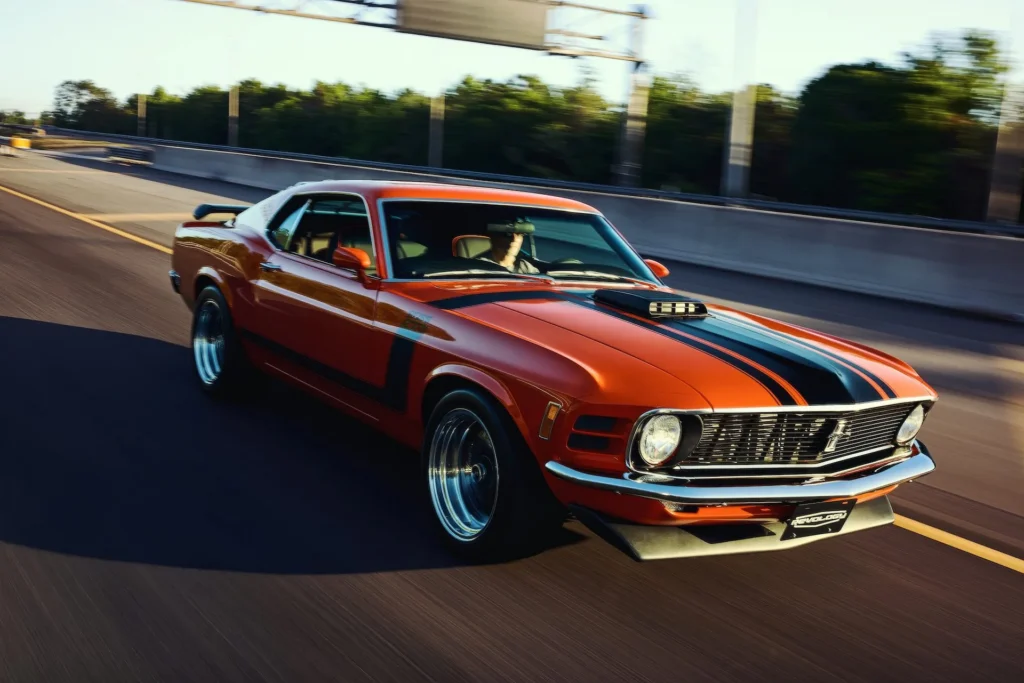
Yes, a Revology classic Mustang can deliver modern performance in a vintage body. Revology Cars builds its 1970 Boss 302 reproduction around a modern 5.0L Ford “Coyote” V8 producing 460 horsepower, paired with either a six-speed manual or a ten-speed automatic transmission. According to Autoevolution, the base price starts at $375,000 and can exceed $426,000 fully loaded. Tom Scarpello, founder of Revology Cars, describes the 1970 Boss 302 reproduction as a “race car for the street”. For enthusiasts who intend to drive regularly and want the emotional experience of a Boss 302 without the mechanical limitations of a 50-year-old platform, Revology’s approach is optimized for reliability and represents a genuinely compelling option in the reproduction segment.
What Are the Key Takeaways About the Mustang Boss 302 vs Shelby GT350 Performance Comparison?
The key takeaways from the Mustang Boss 302 vs Shelby GT350 performance comparison are that each car excels in a distinct performance context. The GT350 holds a clear circuit advantage: according to Car and Driver’s Lightning Lap data, the 2016 GT350R lapped 11 seconds faster than the 2012 Boss 302 Laguna Seca (2:51.8 vs. 3:02.8). In straight-line performance, a 2019 GT350 completed the quarter-mile in 12.3 seconds at 117.0 mph. The Boss 302 counters with a more accessible price point and a high-revving 5.0L character that earned legendary status in its own right. Buyers focused on track precision may favor the GT350; those drawn to raw mechanical engagement and collectibility will find the Boss 302 equally rewarding.