
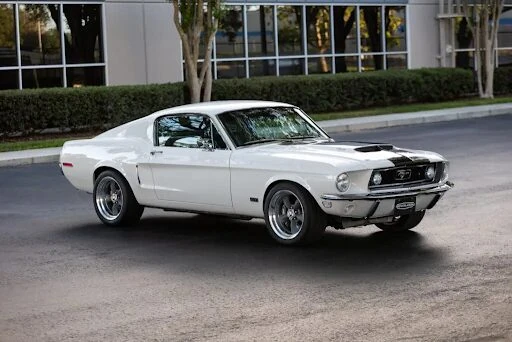
The 1968 Mustang is not merely a collector’s item; it is a foundational pillar of American automotive history. As noted by historical production records, Ford produced over 317,000 units in 1968, embedding the driving experience of the GT into the collective consciousness of enthusiasts worldwide.
Yet, with such widespread familiarity comes a tendency to view the past through rose-colored glasses. While we celebrate the aesthetic and auditory soul of the original 1968 GT, the experience often included less romantic elements: vapor lock in traffic, vague on-center steering, and fade-prone brakes. It is this specific gap between the legendary silhouette and the vintage engineering that we aim to close.
At Revology Cars, we do not simply restore. We re-engineer. By placing the original 1968 Mustang GT for sale against the Revology reproduction, we reveal exactly how we preserve the soul of an icon while eliminating the compromises of vintage engineering. This is a technical deep dive into the driving experience of two vehicles that share a silhouette but live in different worlds of performance.
Power Delivery and Engine Dynamics
The heart of any Mustang is its engine. In 1968, displacement was king, but today, efficiency and power density rule the road. The difference between these two philosophies defines the vehicle’s character, shifting from a raw, temperamental machine to a refined, high-performance tourer.
Living with the Legend: The FE Big Block
In 1968, the pinnacle of the Mustang GT experience was defined by the FE big-block V8s, specifically the 390 cubic-inch S-code, and the mid-year introduction of the legendary 428 Cobra Jet. Driving an original 1968 GT is a raw, mechanical event that demands patience. As noted by the Auto Editors of ConsumerGuide Automotive, while Ford conservatively rated the 428 Cobra Jet at 335 horsepower, real-world output was often estimated closer to 410 horsepower to placate insurance adjusters.
The start-up ritual is specific. You pump the gas pedal twice to prime the carburetor, turn the key, and hope the automatic choke engages correctly without flooding the engine.
Once alive, the idle is lumpy and rich, filling the garage with the nostalgic scent of unburnt hydrocarbons. On the road, the torque is immediate but delivered in a narrow power band. The 3-speed C6 automatic transmission, while durable, is a product of its time. It lacks an overdrive gear, meaning that at 70 mph with a performance axle ratio, the engine is screaming at nearly 3,000 RPM. This creates a cabin drone that turns long-distance touring into an endurance test rather than a pleasure cruise. Furthermore, throttle response suffers from the inherent lag of a vacuum-operated secondary carburetor system, making precise inputs difficult during spirited driving.
Redefining Performance: The Gen 4 Coyote V8
The Revology 1968 GT radically alters this dynamic without losing the V8 soul. Under the hood lies the Ford Gen Gen 4 5.0L Ti-VCT DOHC “Coyote” V8, which Ford Performance specifications list at a robust 460 horsepower and 420 lb-ft of torque with a high 12.0:1 compression ratio. Revology is currently in the process of transitioning to the Gen 4 Coyote engine. This is not just about peak numbers. It is about the sophistication of delivery. The Coyote engine utilizes variable cam timing (Ti-VCT) to optimize power across the entire rev range, eliminating the dead spots common in vintage carbureted engines.
The driving experience is further transformed by the 10R80 10-speed automatic transmission (or the T-56XL 6-speed manual for purists). Where the original car ran out of breath, the Revology GT pulls relentlessly to a 7000+ RPM redline. Cruising at 80 mph is now a whisper, with the engine ticking over at under 2,000 RPM in overdrive, significantly improving fuel economy and cabin comfort.
The canyon in the torque curve is gone, replaced by linear, predictable power delivery managed by modern engine management systems. You get the authentic V8 burble through a Borla stainless steel exhaust system, tuned to eliminate drone, but you lose the cold-start tension. You press the start button, and it runs perfectly, every time, at any altitude or temperature.
Mastering the Curve: Steering and Suspension
The philosophy of handling has evolved dramatically over the last five decades. While the original Mustang was designed for straight-line speed, the Revology reproduction is engineered to conquer corners with the poise of a modern European sports car.
The Struggle of Vintage Geometry
The original 1968 suspension geometry was designed for a different era of bias-ply tires and lower speeds. The steering box was a recirculating-ball setup that, even when new, had a significant dead spot at the center. To drive an original GT is to be constantly correcting the wheel, sawing back and forth to keep the car tracking straight, especially on crowned roads.
Cornering in a stock 1968 GT is a lesson in weight transfer and chassis flex. The front suspension, a coil-spring design on the upper and lower arms, coupled with a solid rear axle on leaf springs, results in significant body roll. Push the car hard into a bend, and the nose dives while the heavy iron block pushes the front tires into understeer. This behavior is one of the key features 1968 mustang gt enthusiasts note when comparing it to modern performance standards. Hitting a mid-corner bump often results in axle tramp or hop, where the rear tires lose contact with the pavement, unsettling the chassis and reducing driver confidence.
Precision Engineering: The Modern Chassis
We believe a reproduction Mustang can handle like a modern sports car. The Revology chassis abandons the antiquated steering box in favor of a power rack-and-pinion system. The result is immediate, tactile feedback where you point, and the car follows with standout precision.
The transformation continues with the suspension architecture. We utilize a double wishbone front suspension and a sophisticated 3-link rear suspension with a torque arm and Panhard rod. This setup eliminates the binding inherent in leaf springs and precisely locates the rear axle.
Driving the Revology GT through a winding coastal road reveals a flat, composed chassis. The car settles into corners immediately, using modern Michelin Pilot Sport 4S high performance tires (245/45ZR17) to handle lateral G-forces that a classic GT struggles to handle. The chassis rigidity is further bolstered by laser-cut subframe connectors and an X-brace, making the platform feel as solid as a modern unibody luxury coupe, virtually eliminating the cowl shake often associated with vintage chassis designs.
Stopping Power: From Anxiety to Authority
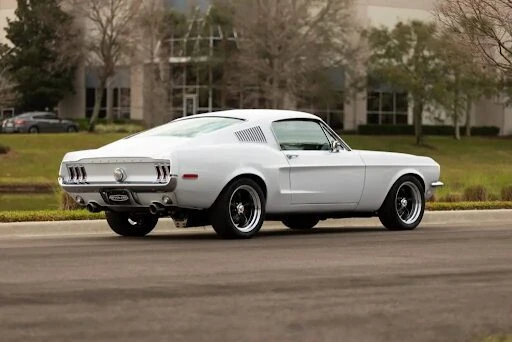
Horsepower is meaningless without the ability to control it. The braking systems of the 1960s were adequate for the era, but they fall woefully short of modern safety standards and driver expectations.
The Limitations of 60s Braking Technology
By 1968, the GT package included power front disc brakes as standard equipment, a significant step up from the drum brakes found on base models. However, these were single-piston floating calipers acting on small rotors. In modern traffic conditions, where sudden stops from 70 mph are common, these original brakes are inadequate. This is a crucial consideration for anyone looking to maintain a classic Mustang GT, as drum brakes on older models often require frequent maintenance. Upgrading to modern four-wheel power discs is often the first step in ensuring the car remains safe and driveable on today’s roads.
According to data from the Bureau of Transportation Statistics, the fatality rate per 100 million vehicle miles traveled in the 1960s was nearly 5.5, compared to just 1.1 today, a discrepancy largely attributed to the lack of modern safety systems like effective braking and stability control.
The pedal feel in a classic GT is often wooden or inconsistent. Repeated hard stops lead to rapid heat buildup and brake fade, causing the pedal to go to the floor and the car to fail to decelerate effectively. This limitation forces the driver to leave massive gaps in traffic and plan stops well in advance, permeating the driving experience.
Street Ready Performance: 6-Piston Deceleration
The Revology 1968 GT comes standard with a massive braking system designed to handle 460+ horsepower. We utilize 12.88-inch slotted and ventilated rotors clamped by 6-piston calipers in the front and 4-piston calipers in the rear.
The driving difference is night and day. The pedal is firm and linear, allowing for precise modulation (trail braking) entering corners. In a panic stop situation, the system engages with authority, repeatedly bringing the car to a halt without fade.
This allows you to drive the Revology GT aggressively, knowing the stopping power matches the acceleration. Furthermore, the reduction in unsprung weight provided by the modern caliper design improves suspension response, further tying the braking and handling characteristics into a cohesive performance package.
Cabin Comfort and Build Quality
The interior of a car is where the driver spends all their time, and it is here that the gap between 1968 and today is most palpable. Revology bridges this gap by retaining the aesthetic while completely overhauling the ergonomics and acoustics.
The Authentic Acoustic Experience (and its Drawbacks)
The driving experience of the 1960s was loud. Wind whistles through the vent windows, road noise resonates through the thin floorpans, and the doors shut with a metallic clang. The interior ergonomics of 1968 were basic at best. The seats were flat with zero lateral support, causing the driver and passenger to slide around during cornering.
Climate control was also a primitive affair. The factory “SelectAire” air conditioning, while integrated into the dash by 1968, struggled to cool the cabin efficiently compared to modern standards. On hot days, even with the AC running, the cabin can still feel like a greenhouse, detracting significantly from the driver’s enjoyment.
Engineered Silence: A Grand Tourer for Today
A Revology car is designed to be a daily driver, capable of cross-country trips in absolute comfort. We mitigate Noise, Vibration, and Harshness (NVH) with obsessive detail. The body is lined with modern sound-deadening materials before your choice of molded nylon loop carpet with mass backing or 100% wool German square-weave carpet is installed. We use bonded glass and modern door seals to eliminate wind noise. When you close the door of a Revology GT, it latches with a solid, reassuring thunk characteristic of high-end European vehicles.
Inside, the aesthetic is pure 1968, but the materials are 2025. The seats may look vintage, but they are power-adjustable, bolster-equipped buckets trimmed in Premium Vinyl or Premium Nappa Leather. The air conditioning is a modern, integrated system that can keep the cabin at a crisp 68 degrees even in the desert heat. The most subtle but impactful difference is the electronics. The instrument cluster looks analog, but features LED lighting and digital message centers. The audio system connects via Bluetooth to your smartphone, playing through a Focal Access Series speaker system that delivers high-fidelity sound clarity the original AM radio could never dream of.
The Icon, Perfected for the Modern Day Driver
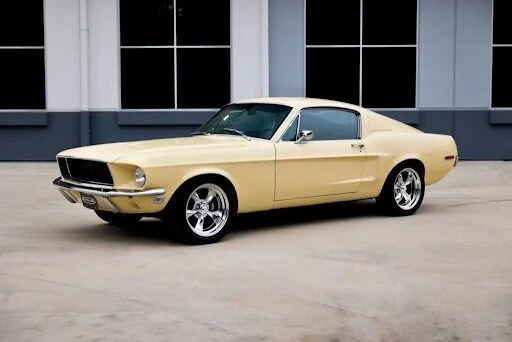
The driving experience of an original 1968 GT is a time capsule. It is charming, demanding, and flawed. It requires a driver who is a mechanic at heart, willing to forgive its shortcomings for a taste of history. It is a relationship of compromise.
The Revology 1968 GT offers something different. It is the idealized version of that history. It allows you to experience the aesthetic beauty and cultural weight of the Mustang GT without the limitations. You get the thumbs up from pedestrians and the soul-stirring V8 soundtrack, but you also get a car that starts every time, stops on a dime, and carves corners with precision. It is not just about making the car faster. It is the 1968 GT, perfected for the modern world.
Experience the difference engineering makes. Explore our available inventory or contact a specialist to commission your bespoke 1968 GT reproduction.