

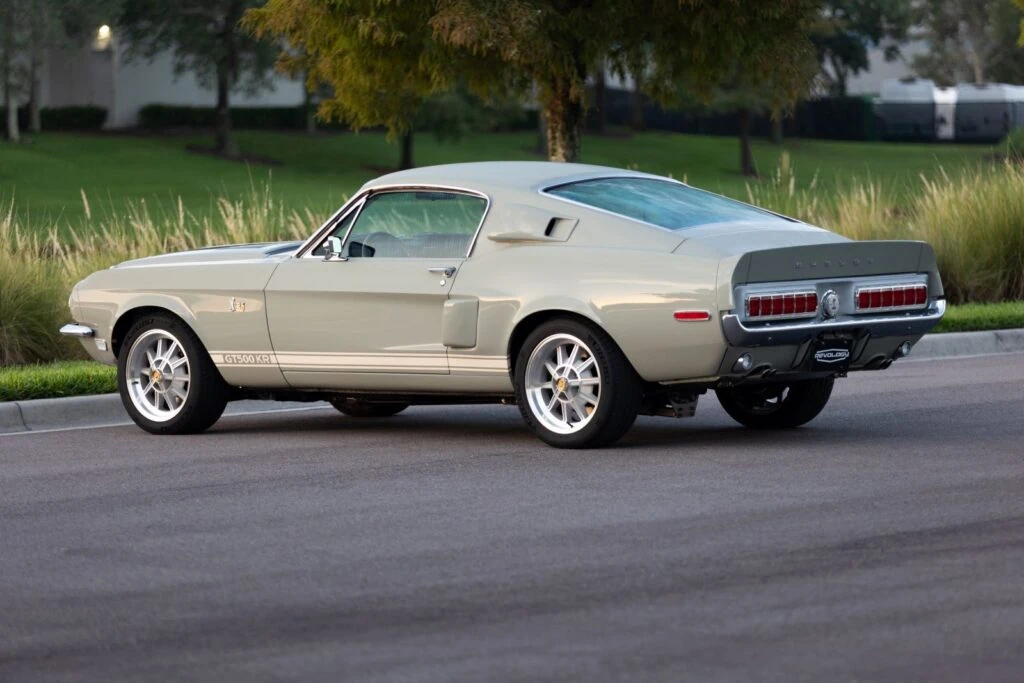
The 1968 Shelby GT500KR is a distinct evolution within the Shelby Mustang lineage, separating itself from earlier models through targeted engine, chassis, and refinement changes that reshaped the driving experience. We cover the driving character of earlier Shelby Mustangs, the specific engineering changes the GT500KR introduced, how those changes translate to real-world driver feel, how modern reproductions preserve or enhance the classic experience, and how Revology Cars connects enthusiasts with these iconic machines.
Early Shelbys ranged from lightweight, high-revving small-block GT350s built for road racing to heavier, big-block GT500s tuned for straight-line boulevard power. Each generation carried a raw, mechanical character defined by its era’s engineering constraints and Carroll Shelby’s evolving vision.
The GT500KR’s core distinction centers on its 428 Cobra Jet V8, which replaced the earlier Police Interceptor engine with redesigned cylinder heads, improved induction, and larger exhaust manifolds. Upgraded suspension components, power brakes with larger rear drums, and power steering accompanied the drivetrain swap.
Behind the wheel, these changes produce a car that pulls harder through the midrange, corners with greater composure, and rewards longer drives with less fatigue than its predecessors. The GT500KR balances raw muscle-car thrust with improved street tractability and refinement compared with earlier Shelby models, which were more firmly oriented toward high-performance, race-inspired tuning.
For enthusiasts who want the GT500KR’s visceral feel paired with modern reliability, contemporary reproductions use fuel-injected V8s, independent suspensions, and updated safety hardware to close the gap between classic character and current expectations. Revology Cars builds officially licensed Shelby reproductions that honor original design intent while integrating these modern components.
What Were the Driving Characteristics of Earlier Shelby Mustangs?
The driving characteristics of earlier Shelby Mustangs ranged from raw, race-bred agility in the small-block GT350s to brute-force muscle in the big-block GT500s. Below, we examine how classic Shelby handling stood out and what defined each model’s strengths and limitations.
How Did Classic Shelby Handling and Performance Stand Out in Their Era?
Classic Shelby handling and performance stood out through a combination of aggressive suspension tuning, high-revving powertrains, and race-derived engineering that separated these cars from standard Mustangs. Early GT350s, in particular, were developed with competition homologation in mind, which gave them a directness and mechanical feedback that few production cars of the mid-1960s could match.
That visceral connection between driver and machine came at a cost, though. Ride quality was stiff, road noise was significant, and the cars demanded attention from the driver at all times. For classic Shelbys built before 1983, the Shelby American Automobile Club considers a letter from a SAAC registrar as one of the most authoritative sources for verifying authenticity, underscoring how seriously the community treats provenance for these purpose-built machines.
What Were the Signature Features and Shortcomings of Previous Shelby Models?
Shelby models are defined by a combination of signature performance features and evolving design trade-offs. Early cars like the Shelby GT350 emphasized lightweight construction, high-revving V8 performance, and strong motorsport influence. As the lineup developed into later models such as the Shelby GT500KR, the focus shifted toward higher torque, increased comfort, and improved street drivability.
The main trade-offs of this evolution included increased vehicle weight, less agile handling compared with the earliest Shelby designs, and a gradual transition away from the pure race-oriented character that defined the brand’s earliest development phase.
Total production for the 1965 Shelby GT350 was just 562 units, including 34 factory competition models. That exclusivity reflected Carroll Shelby’s original vision: a stripped-down, performance-first machine. As Brandan Gillogly of Hagerty Media notes, the GT350s were “high-revving, small-block-powered fastbacks” and “road-race champions,” while the GT500 was the “more musclebound Shelby” built for those who “wanted a street car that could hang with the big-blocks on the boulevard.”
By 1969, the GT500 produced 335 horsepower and 440 lb-ft of torque from its 428 Cobra Jet V8, reaching 60 MPH in 6.0 seconds. The trade-off was substantial; at nearly 3,850 pounds by 1970, later Shelbys sacrificed the nimble character that made the original GT350 a legend. Understanding these evolving priorities sets the stage for how the GT500KR carved out its own distinct identity.
What Specific Changes Did the GT500KR Introduce Over Its Predecessors?
The GT500KR introduced a more powerful engine and refined chassis components over earlier Shelby GT500 models. Below, each upgrade is broken down by powertrain and suspension.
How Did the Engine and Drivetrain in the GT500KR Evolve?
The engine and drivetrain in the GT500KR evolved through the adoption of Ford’s 428 Cobra Jet V8, replacing the 428 Police Interceptor used in the standard GT500. This single change redefined the car’s character. The Cobra Jet featured redesigned cylinder heads with improved induction and larger exhaust manifolds, resulting in significantly improved airflow compared to the Police Interceptor, according to MustangSpecs data on the 1968 GT500KR.
While the official rating dropped to 335 horsepower (versus earlier GT500 horsepower figures ranging from around the mid-350 to 360 range), the Cobra Jet’s real-world output was widely understood to exceed that number. The conservative rating was a strategic move for insurance purposes. In practice, the KR delivered stronger low-to-mid-range torque and more usable power across the rpm band, making it feel noticeably more responsive from a roll than its predecessor.
In What Ways Did Suspension and Chassis Upgrades Affect Driving Feel?
Suspension and chassis upgrades affected driving feel by giving the GT500KR a more composed, confidence-inspiring character on the road. For the 1968 model year, Shelby equipped the GT500 platform with top-of-the-line Mustang suspension components, power steering, power brakes with larger rear drums, and an 8,000-rpm tachometer.
These changes addressed complaints common to earlier Shelbys, where raw power often overwhelmed the chassis. Larger rear brake drums improved stopping consistency under hard use, while power steering reduced the physical effort required at low speeds. Together, the refinements shifted the GT500KR’s personality from a car that demanded constant driver management toward one that rewarded spirited driving without punishing daily use. Understanding these mechanical upgrades sets the stage for how they translate into real-world driving sensations.
How Does the GT500KR’s Performance Impact the Driver’s Experience?
The GT500KR’s performance impacts the driver’s experience through stronger low-to-mid-range torque delivery, improved daily driveability, and a more refined chassis compared to earlier Shelbys. The following sections explore acceleration feel and the balance between comfort and power.

What Does Acceleration and Road Handling Feel Like Compared to Prior Models?
Acceleration and road handling in the GT500KR feel distinctly different from prior Shelby models because the 428 Cobra Jet V8 prioritizes massive lower-end torque over high-rpm power. Earlier GT350s rewarded drivers who kept the small-block 289 spinning near redline; the GT500KR delivers its 440 lb-ft of torque as a broad, rolling surge from idle through mid-range. That low-effort power delivery changes the entire driving rhythm, making highway merging and boulevard cruising feel effortless rather than demanding.
Road handling reflects a heavier, more planted car. At 3,570 lbs, the GT500KR carries roughly 200 more pounds than the 1967 GT500, yet power steering and larger rear brake drums give the driver more confidence during transitions. For enthusiasts who value accessible, usable power over razor-sharp track reflexes, the GT500KR represents a meaningful evolution in how a Shelby communicates with its driver.
How Is Comfort Balanced With Raw Power in the GT500KR?
Comfort is balanced with raw power in the GT500KR through a deliberate combination of upgraded amenities and a conservatively rated but potent drivetrain. According to Hagerty Media, Shelby equipped the 1968 model with top-of-the-line Mustang suspension, power steering, power brakes with larger rear drums, and a tachometer reading up to 8,000-rpm.
These additions softened the GT500KR’s daily-driving character considerably. Where the race-car harshness of the 1965 GT350R at just 2,550 lbs and 350 horsepower could be felt by occupants, the KR wrapped similar straight-line performance in a more civilized package. Enthusiasts frequently note the GT500KR is “easier to live with every day” than the 1967 GT500, due to its torque-rich Cobra Jet engine and incremental refinements in chassis tuning that improved overall drivability. That willingness to prioritize street comfort without sacrificing the Cobra Jet’s authority is what made the “King of the Road” a Shelby built for real-world road use.
With the driving experience defined, modern reproductions now offer ways to preserve that character using contemporary engineering.
How Do Modern Reproductions Capture or Enhance the Classic GT500KR Driving Experience?
Modern reproductions capture the classic GT500KR driving experience by pairing period-correct styling with contemporary powertrain, chassis, and braking system technology. The subsections below explore how fuel-injected V8s and independent suspensions transform the driving feel, and how modern engineering improves safety and reliability.
What Role Do Modern Components Like Fuel-Injected V8s and Independent Suspensions Play?
Modern components like fuel-injected V8s and independent suspensions play a central role in bridging the gap between vintage character and modern capability. Fuel injection replaces the original carburetor setup, delivering consistent power across altitude, temperature, and throttle input without the cold-start issues or vapor lock that plagued 1960s induction systems. A modern 5.0-liter supercharged V8, for example, can produce 710 horsepower according to a Top Gear first-drive review of a Revology Shelby GT500. An unequal-length modern control arm front suspension, also known as a double wishbone design, replaces the original front suspension originally designed for the 1959 Ford Falcon. This yields sharper turn-in, reduced body roll, and more predictable weight transfer. For enthusiasts who value driving, these upgrades make the feel of the GT500KR’s visceral torque accessible on modern roads.
How Does Contemporary Engineering Improve Safety and Reliability?
Contemporary engineering improves safety and reliability by addressing the structural and mechanical limitations inherent in 1960s Mustang design. Reengineered reproduction builds assembled from new body structure components eliminate decades of metal fatigue, corrosion, and collision-compromised geometry that affect surviving originals. Modern disc brake systems at all four corners dramatically shorten stopping distances compared to the original front-disc, rear-drum configuration. Upgraded electrical systems with modern wiring harnesses reduce fire risk and support reliable accessory operation. Sealed cooling systems with electric fans maintain consistent operating temperatures, solving the overheating problems common to high-output big-block engines in stop-and-go traffic. It is worth noting that these improvements do not diminish the collectibility of original GT500KRs; rather, they offer a parallel path for those who prioritize regular driving over preservation.
With the driving experience refined through modern engineering, Revology Cars offers a specific path to ownership for enthusiasts drawn to these classic Shelbys.
How Can Revology Cars Help Enthusiasts Experience the Unique Feel of the GT500KR and Other Classic Shelbys?
Revology Cars can help enthusiasts experience the GT500KR and other classic Shelbys through officially licensed reengineered restoration builds that pair iconic styling with modern engineering. Below, we cover Revology’s Shelby offerings and the key distinctions that made the GT500KR feel different from earlier models.

What Officially-Licensed Reengineered Restoration Services Does Revology Offer for Shelby Models?
Revology Cars offers officially licensed reengineered restoration builds for Shelby models, including the 1967 Shelby GT500 and 1968 Shelby GT500KR, built with new components and contemporary drivetrain technology. According to Hagerty, a Revology Shelby GT500 Mustang carries a base price of $342,500, with tested models reaching $363,575 out the door. For enthusiasts who want to drive a classic Shelby regularly rather than preserve one in a collection, Revology’s approach delivers the iconic look with modern reliability. Collectors focused on original, matching-numbers cars will find equal value in preserving authentic examples through different channels.
What Are the Key Takeaways About How the GT500KR Feels Different From Earlier Shelby Models We Covered?
The key takeaways about how the GT500KR feels different from earlier Shelby models center on its shift from race-bred rawness to refined street muscle. With only about 933 fastbacks and 318 convertibles produced, the GT500KR remains one of the rarest Shelby variants, yet its 428 Cobra Jet V8 made it more livable than the stripped-down GT350s that preceded it.
Production moving from Carroll Shelby’s Los Angeles facility to the A.O. Smith Corporation in Ionia, Michigan in 1968 reflected this broader transformation toward volume and grand touring comfort. Whether experienced through an original example or a Revology reengineered restoration build, the GT500KR represents a moment showing the evolution of Shelby Mustangs from focused competition machines into powerful, street-oriented performers that balanced raw power with everyday usability.