

The 1968 Ford Mustang GT 2+2 Cobra Jet is a fastback muscle car defined by aggressive bodywork, performance-specific trim, and a cohesive design language that signals power from every angle. We cover its exterior design elements, front-end styling, rear and side details, interior appointments, original color options, design legacy, and how Revology Cars reproduces this icon with modern engineering.
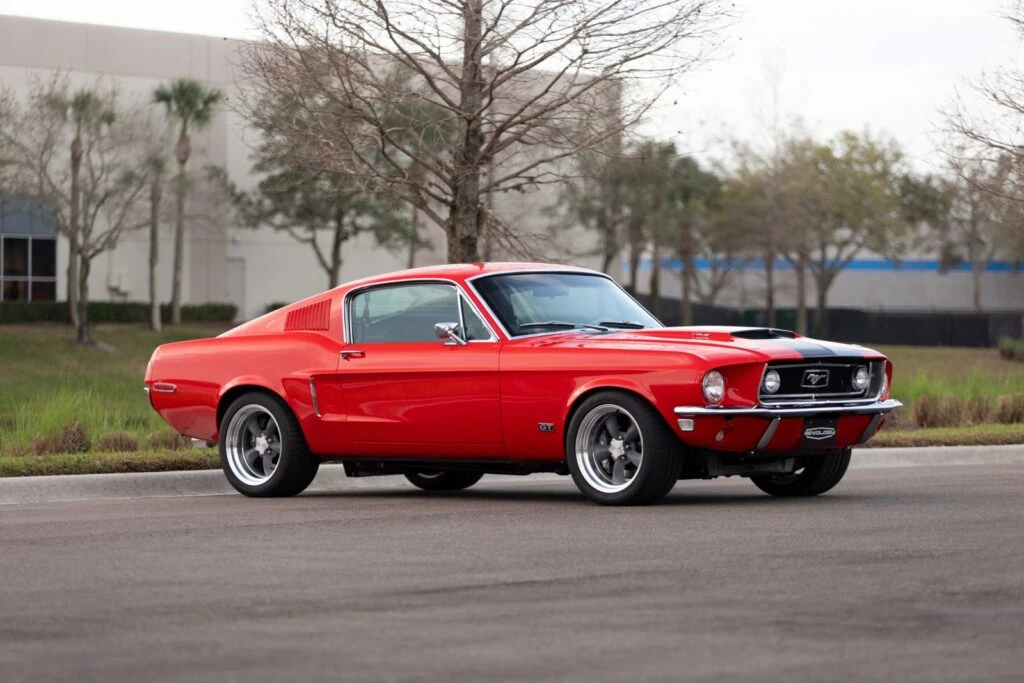
The exterior combines a sweeping fastback roofline with functional components like a fiberglass hood scoop, GT fog lamps, tapered fender stripes, and distinctive understated badges that separate the Cobra Jet from standard Mustangs. F70-14 wide-oval tires on 14×7” 12-slotted steel wheels reinforce the car’s purpose-built stance.
Up front, a recessed grille flanked by quad headlights and 4-inch fog lamps creates an unmistakable face, while the rear features a GT flip-open gas cap, three-segment taillights, and a clean valance that anchors the car’s proportions.
Inside, Comfort Weave vinyl seat inserts, wood-grained instrument panel trim, and a driver-focused console layout balance sportiness with usability. Every interior surface complements the exterior’s performance identity.
Ford offered a vivid palette ranging from Highland Green Poly and Candyapple Red to rare special-order finishes, giving each of the 1,044 Cobra Jet fastbacks produced a distinct visual personality. These colors, verifiable through original production records, remain central to the car’s collectibility.
The 1968 Cobra Jet’s design cues influenced subsequent Ford Mustang generations, and Revology Cars preserves those authentic 1960s aesthetics while integrating a structurally reinforced unibody and modern conveniences for today’s enthusiasts.
What Exterior Design Features Distinguish the 1968 Mustang GT 2+2 Cobra Jet?
The exterior design features that distinguish the 1968 Ford Mustang GT 2+2 Cobra Jet include its sweeping fastback roofline, functional hood scoop, GT-specific striping and badging, and wide-oval tire and wheel package. Each element below contributes to the car’s unmistakable presence.
How Does the Fastback Body Style Influence the Car’s Appearance?
The fastback body style influences the car’s appearance by creating a continuous, sweeping roofline that slopes from the cabin to the rear deck. This 2+2 profile gives the 1968 Ford Mustang a lower, wider visual stance compared to the hardtop and convertible variants. That flowing roofline became one of the most recognizable silhouettes in American muscle car history, and it remains a defining reason collectors and enthusiasts are drawn to this particular body style over other configurations.
What Are the Notable Hood and Scoop Details Unique to This Model?
The notable hood and scoop details unique to this model center on a functional ram-air induction system designed to force cool air directly into the 428 Cobra Jet engine. According to the Mustang 428 Cobra Jet Registry, Ford used a functional fiberglass hood scoop identified by basic part number 16C630, with three distinct versions produced during the 1968 model year, reflecting running production changes. Unlike purely decorative scoops found on lesser models, the Cobra Jet scoop served a genuine performance purpose, channeling ambient air to improve volumetric efficiency at wide-open throttle.
In What Ways Do the Stripes, Badges, and Emblems Convey Cobra Jet Identity?
The stripes, badges, and emblems convey Cobra Jet identity through a layered system of visual cues exclusive to GT-equipped cars. The GT Equipment Group added a tapered GT stripe starting on the forward portion of the front fender, flowing rearward along the body line. GT lettering on the fenders, a “GT” flip-open gas cap, and small engine displacement callouts completed the exterior badging hierarchy. Notably, the 428 Cobra Jet did not receive its own large-scale hood emblem from the factory. This understated approach, especially compared to later muscle cars, gave these cars a sleeper quality that many enthusiasts consider part of their lasting appeal.
How Do Wheels and Tires Affect the Car’s Overall Look?
Wheels and tires affect the car’s overall look by filling the wheel wells and communicating the mechanical capability underneath. According to Hot Rod Magazine, the 1968 428 Cobra Jet Mustang typically used F70-14 tires mounted on 14×6-inch stamped-steel slotted road wheels with bright trim rings and GT center caps as part of the GT package. The wider F70-14 rubber gave the car a noticeably more planted stance than standard Mustang tire sizes, signaling serious performance intent from any angle. Styled steel wheels were also available, often paired with wide-oval tires to improve grip and performance. These wheel and tire combinations strike a purposeful balance between form and function that defined the late-1960s muscle car aesthetic.
With the exterior silhouette established, the front end carries its own set of distinguishing details.
How Does the Front End Set the 1968 Mustang GT 2+2 Cobra Jet Apart?
The front end sets the 1968 Mustang GT 2+2 Cobra Jet apart through its distinctive grille-mounted fog lamps, aggressive headlight arrangement, and chrome bumper detailing. The following sections cover the grille and headlight design, plus the bumper and fog light integration.

What Grille and Headlight Features Stand Out on This Model?
The grille and headlight features that stand out on this model are the wide-mouth horizontal grille opening and recessed headlamp bezels. Ford gave the 1968 Mustang a cleaner front face compared to the 1967 model, removing the previous year’s floating corral emblem from the grille center. Quad headlights sit in individual chrome-trimmed housings, flanking the central grille opening. This arrangement creates a wider, lower visual stance that emphasizes the car’s performance intent. For many enthusiasts, the 1968 grille redesign remains one of the most recognizable front-end treatments in the entire first-generation Mustang lineup.
How Do the Bumper and Fog Lights Enhance the Visual Impression?
The bumper and fog lights enhance the visual impression by adding layered depth and functional aggression to the front fascia. According to the 1968 Ford Mustang brochure, the GT Equipment Group included 4-inch fog lamps positioned at each end of the grille, along with a new tapered GT stripe starting on the forward portion of the front fender. The chrome front bumper wraps tightly around the grille opening, framing those fog lamps as integrated design elements rather than afterthoughts. Together, the fog lamps and bumper give the Cobra Jet’s face a purposeful, road-ready look that immediately separates GT-equipped cars from base Mustangs. With the front end establishing this visual authority, the rear and side styling elements carry that performance identity around the rest of the body.
What Are the Defining Rear and Side Styling Elements of the 1968 Mustang GT 2+2 Cobra Jet?
The defining rear and side styling elements of the 1968 Mustang GT 2+2 Cobra Jet include distinctive taillights, a performance-oriented rear valance with a GT gas cap, sculpted side scoops, and sweeping quarter panel lines. These details reinforced the car’s muscular identity across a color palette of sixteen plus factory shades.
How Do the Taillights and Rear Valance Convey Its Performance Character?
The taillights and rear valance convey performance character through bold, vertically segmented lamp housings set into a concave rear panel. The wider, recessed taillights gave the rear end a planted, aggressive stance that signaled serious capability. According to Ford Heritage documentation, a key visual marker for the 1968 GT Equipment Group is the presence of the “GT” flip-open, quick-action gas cap on the rear valance. Centered between the taillights, this chrome cap served as an unmistakable identifier separating GT models from standard Mustangs. The valance itself sat low and clean, framing dual exhaust tips that completed the rear composition. For enthusiasts verifying originality, the gas cap remains one of the quickest authentication points on any 1968 GT.
In What Ways Do Side Scoops, Windows, and Quarter Panels Add Visual Flair?
Side scoops, windows, and quarter panels add visual flair by breaking up the fastback’s long body surfaces with purposeful contours. The 2+2 roofline sweeps rearward in an uninterrupted arc, creating a signature design that Ford would be known for for years to come. The 1968 Mustang GT 2+2 (428 Cobra Jet) incorporates Ford’s Silent-Flo Ventilation system, which routes cabin air through concealed rear outlet paths integrated into the fastback quarter and sail panel structure. This system improves interior airflow without the need for open windows. Along the lower body sides, the clean sheetmetal and subtle sculpting reflect the car’s performance-oriented design language without the use of functional external scoops or vents.These elements looked especially striking across the ten factory colors available in 1968, from Highland Green Poly (Code R) to Meadowlark Yellow (Code W). With rear and side styling covered, the interior design reveals how the cockpit matched this exterior performance focus.
How Does the Interior Design of the 1968 Mustang GT 2+2 Cobra Jet Reflect Its Performance Focus?
The interior design of the 1968 Mustang GT 2+2 Cobra Jet reflects its performance focus through purpose-built upholstery, driver-oriented instrumentation, and a console layout that balances sportiness with comfort.
What Special Upholstery, Trim, and Instrumentation Are Found Inside?
The special upholstery, trim, and instrumentation found inside include breathable seat inserts, wood-grained accents, and a full-gauge instrument cluster. According to the 1968 Ford Mustang brochure, “Comfort Weave” breathable vinyl seat inserts were offered for Hardtop and Fastback models, providing grip and ventilation during spirited driving. The instrument panel could be equipped with simulated wood-grain trim when the Deluxe Interior (Luxury Interior/Interior Décor Group) option was specified, lending a refined contrast to the cabin’s otherwise performance-driven character. Round gauges housed oil pressure, temperature, and ammeter readings directly in the driver’s line of sight. For a car built around the 428 Cobra Jet engine, this instrumentation gave drivers real-time feedback that matched the mechanical intensity under the hood.
How Are Comfort and Sportiness Expressed Through Controls and Console Design?
Comfort and sportiness are expressed through controls and console design by centering critical inputs within immediate reach of the driver. The optional center console housed the shifter, whether a four-speed manual or Cruise-O-Matic automatic, in a layout that encouraged quick, deliberate gear changes. Padded armrests and integrated storage added everyday usability without cluttering the cockpit. Toggle-style switches and a deeply recessed steering wheel reinforced the sporting intent, while thick carpeting and sound-deadening materials kept road noise manageable during highway cruising. This balance is what makes the Cobra Jet’s interior compelling; it never sacrificed daily livability for the sake of raw performance, yet every design choice still served the driver first. Understanding how interior details reflect performance intent helps frame the equally deliberate exterior color choices Ford offered.
What Original Color Options and Paint Finishes Were Available for the 1968 Mustang GT 2+2 Cobra Jet?
The original color options for the 1968 Ford Mustang GT 2+2 Cobra Jet spanned Ford’s full production palette plus special-order finishes. Popular standard colors and rare limited-production hues each shaped the car’s visual character.
How Did Popular Paint Choices Shape the Mustang’s Visual Identity?
Popular paint choices shaped the Mustang’s visual identity by pairing bold, era-defining colors with the fastback’s aggressive lines. Ford offered a diverse standard palette for 1968, including Candyapple Red, Highland Green Poly, Meadowlark Yellow, Wimbledon White, Acapulco Blue Poly, Lime Gold Poly, and Presidential Blue Poly, among others.
Highland Green, made famous by the Bullitt Mustang GT 390, became closely associated with the late-1960s Mustang performance era, during which the 428 Cobra Jet established Ford’s factory drag racing dominance, while Candyapple Red and Meadowlark Yellow gave the 428 Cobra Jet an unmistakable street presence. According to Kevin Marti of Marti Auto Works, Marti Reports confirm the visual authenticity of 1968 Mustangs by matching a vehicle’s VIN to original Ford production records, including specific paint and trim codes. For collectors and enthusiasts verifying an original finish, these reports remain the definitive resource.
What Role Did Special-Order Colors or Limited Editions Play in Its Appearance?
Special-order colors played a significant role in distinguishing individual 1968 Mustang GT 2+2 Cobra Jets from standard-production examples. According to Classic Industries, special order colors were available for the 1968 Mustang, including “Special Orange” (WT5107), which was used on a very limited number of units.
These rare finishes make verified examples exceptionally desirable today. Because only 1,044 R-code fastbacks were produced in 1968, and 706 of those carried the GT Equipment Group with a manual transmission, a special-order color on a Cobra Jet fastback represents an extraordinarily uncommon combination. For buyers weighing originality against personalization, understanding which colors Ford actually offered is essential to preserving historical accuracy.
In What Ways Did the 1968 Mustang GT 2+2 Cobra Jet Influence Future Mustang Designs?
The 1968 Mustang GT 2+2 Cobra Jet influenced future Mustang designs by establishing visual and proportional benchmarks that Ford has revisited across multiple generations. Its fastback silhouette, subtle hood scoop, and GT badging philosophy echo through later models.
How Have Visual Cues from This Model Been Retained or Evolved in Later Generations?
Visual cues from the 1968 Mustang GT 2+2 Cobra Jet have been retained and evolved through consistent references to its proportions, styling elements, and performance-oriented design language. The original fastback measured 183.6 inches long, 70.9 inches wide, and 51.6 inches tall, according to Automobile-Catalog, establishing a low, wide stance that later generations, particularly the 2005 S197 and 2024 S650, deliberately echoed.
Key visual elements that carried forward include:
- The swept-back fastback roofline reinterpreted in performance-focused Mustangs since, like the 2005-2014 Mustang S197
- Hood scoops signaling high-performance engine packages
- GT-specific striping and badging as a visual tier above the base model
- Wide-oval tire and styled wheel pairings that emphasize a planted, aggressive profile
With only 1,299 Cobra Jet Mustangs produced in 1968 (1,044 of them fastbacks), the rarity of the original has only deepened its influence. Ford designers have consistently treated this generation as a touchstone, borrowing its visual vocabulary whenever they want to signal authenticity and muscle car heritage. Few models in automotive history have cast such a long shadow over their successors.
Understanding these design threads helps explain why the 1968 GT 2+2 Cobra Jet remains central to how Revology Cars approaches its own reproduction builds.
How Does Revology’s Reproduction 1968 Mustang GT 2+2 Cobra Jet Combine Classic Visual Appeal with Modern Engineering?
Revology’s reengineered 1968 Mustang GT 2+2 Cobra Jet combines classic visual appeal with modern engineering by preserving period-correct exterior and interior styling while integrating contemporary structural and mechanical upgrades beneath the surface. The following sections cover authentic aesthetics, customization options, and key visual takeaways.

How Does Revology Maintain Authentic 1960s Aesthetics in Their Builds?
Revology maintains authentic 1960s aesthetics by assembling body structures entirely from new parts that replicate the original 1968 Mustang’s proportions, contours, and styling details. According to a Hot Rod Magazine feature, Revology builds each reproduction using an assembly line process with 26 workstations to ensure consistency and quality. Period-correct elements like GT fog lamps, tapered fender stripes, and the flip-open GT gas cap are all faithfully reproduced. Where the difference lies is underneath: the modern unibody uses structural adhesive to elevate torsional rigidity to current standards, a change completely invisible to the eye. For enthusiasts who value the look of an original but want a structure engineered for today’s roads, this approach delivers both without compromise.
What Customization and Modern Convenience Options Does Revology Offer for Enthusiasts?
Revology offers customization and modern convenience options that let buyers tailor each build to their preferences while keeping the classic appearance intact. Interior choices include:
- Premium vinyl or premium Nappa leather upholstery
- Wood-grained instrument panel trim faithful to the original Interior Décor Group aesthetic
- Modern climate control integrated behind period-style controls
Every build is custom, so buyers select their preferred color from palettes inspired by the original 1968 options, choose drivetrain configurations, and specify interior details. This level of personalization matters because it respects the reality that enthusiasts have different priorities; a collector-minded buyer may favor a factory-correct color and trim combination, while a daily driver may prioritize modern comfort features wrapped in vintage styling.
What Are the Key Takeaways About the Visual Characteristics of the 1968 Mustang GT 2+2 Cobra Jet?
The key takeaways about the visual characteristics of the 1968 Mustang GT 2+2 Cobra Jet center on a design language that remains unmistakable more than five decades later. The fastback roofline, functional hood scoop, GT-specific fog lamps, tapered body stripes, and distinctive rear quarter panel vents collectively define one of the most recognizable silhouettes in American automotive history. With only 1,299 Cobra Jet Mustangs produced in 1968, originals are exceptionally rare. Revology Cars preserves every visual detail of that iconic design while building each reproduction on a modernized structure, giving enthusiasts a way to experience the 1968 Cobra Jet’s legendary appearance with the structural integrity and refinement expected today.