

In 2026, high-performance automotive reproduction views color as a declaration of character. The aesthetic landscape has shifted away from novelty paints toward heritage authenticity elevated by modern technology, mirroring the evolution of the mustang gt look over the decades. For enthusiasts commissioning a re-engineered 1960s Mustang or Shelby GT, color selection now balances historical accuracy with investment value.
As expectations for fit, finish, and longevity rise to meet modern luxury standards, the paint process must evolve. It becomes more than merely pigment; it is the final layer of an exacting manufacturing standard designed for durability and depth.
This strategic focus on quality is driving the industry forward, with recent data from Market Research Future projecting the global classic car market to grow significantly. It will reach an estimated value of over $40 billion by the end of 2025 and continue to expand through the next decade.
This guide explores the definitive 2026 color palette, covering heritage hues, modern premium finishes, and the science behind the shine.
The Shift in 2026: Period-Correct Precision vs. Modern Depth
The prevailing trend for 2026 is “Authenticity Amplified.” Collectors and drivers are moving away from the over-saturated “candy” colors that dominated the early 2000s restomod scene. Instead, there is a surging demand for Ford’s original factory colors, but executed with a level of clarity and depth that was technologically impossible in 1967.
In the 1960s, factory paint was often single-stage enamel, prone to oxidation and orange peel. Today, using the Glasurit 55 Line basecoat and high-gloss clearcoat systems, top-tier builders can render classic colors like Wimbledon White or Highland Green with a “liquid” finish. This finish retains the soul of the classic era but offers the UV resistance and depth of a modern car.
The Engineering Difference: It Starts Before the Paint
To understand why specific colors look superior on a high-end reproduction, one must understand the substrate. A paint job is only as good as the body underneath it.
Unlike a typical local body shop restoration, which may rely on heavy fillers to hide imperfections, a precision-assembled body is the foundation of a perfect finish. Advanced manufacturing processes now utilize structural adhesives in conjunction with spot welding, a technique adapted from aerospace and modern luxury auto manufacturing. This increases the torsional rigidity of the unibody by up to 60%.
This matters for color because a stiffer body flexes less. Reduced flex means the paint surface remains stable, allowing for the use of harder, higher-gloss clear coats that might crack on a flexible, vintage chassis. When you choose a color for a high-specification build, you are selecting a finish supported by modern structural engineering.
1. The Undisputed Classics: Heritage Colors Defining 2026
For 2026, three big heritage colors remain a cornerstone of value and style. These shades are historically accurate to the 1966–1968 era and are inextricably linked to the Mustang’s identity.
Wimbledon White (Paint Code M1619)
Wimbledon White is not simply “white.” It is a creamy, warm off-white that served as the canvas for the American racing stripe. It is the signature color of the 1965–1966 Shelby GT350 and remains one of the most requested colors for 1966 Shelby GT350 reproductions.
In an era of harsh, cool-toned LED streetlights, Wimbledon White’s warm, yellow undertones provide a nostalgic softness that pure bright whites like Oxford White lack. It exudes a vintage elegance that pairs exceptionally well with Guardsman Blue LeMans stripes. Ideally, this exterior is paired with a dark Blue or Black interior. For the purist, this remains the logical choice for a GT350 for sale build.
Highland Green Metallic (Paint Code M3067)
Immortalized by Steve McQueen in Bullitt, Highland Green is arguably the most famous Mustang color in history. It is a deep, dark green with a subtle metallic flake that comes alive under direct sunlight but reads as a menacing, near-black forest green in the shade.
Green is experiencing a massive resurgence in the broader automotive luxury market, seen in brands like Aston Martin and Bentley. For a 1968 Mustang GT 2+2 Fastback, Highland Green is the definitive specification. While the original 1968 paint utilized a relatively coarse metallic flake, modern Glasurit applications employ a finer, more uniform metallic particle.
This eliminates the distracting ‘glitter’ effect and enhances the sheen. Broader market trends back this resurgence; the BASF Color Report 2024 indicates a rising popularity in green shades across global markets, signaling a shift towards more natural and vibrant diverse color options in the premium segment.
Raven Black (Paint Code M1724)
In the world of automotive finishing, Raven Black is considered the ultimate stress test for bodywork. Black shows every ripple, every sanding mark, and every imperfection in the steel.
Raven Black remains a top choice for those who want to showcase the flawless precision of a body engineered to perfection. Because modern panels are often new reproductions rather than patched-up vintage steel, builders can achieve a mirror-finish black that is free of the waves commonly seen in restorations. It transforms the Mustang from a pony car into a formal, menacing grand tourer. When paired with the chrome accents of the 1967 Mustang GT, the contrast is striking.
2. The Premium OEM Palette: European Influence
A unique advantage of commissioning a bespoke Mustang is the ability to look beyond the 1960s Ford paint chip book. Manufacturers of custom vehicles often offer premium colors from the palettes of Ferrari, Porsche, and other exotic marques. This trend is exploding in 2026 as clients increasingly seek the silhouette of an American muscle car draped in the sophisticated hues of European exoticism. This fusion creates a “transatlantic” aesthetic that fits perfectly alongside modern 911s or Ferraris in a collection.
Chalk (Porsche Paint Code M9A)
“Chalk” is a non-metallic, light grey that has taken the automotive industry by storm. It sits somewhere between white and grey, offering a flat, pastel-like quality that highlights the sharp lines of the Mustang fastback without the distraction of metallic flake.
This color is trending because it feels technical, modern, and understated. It signals that the car is not an old survivor, but a contemporary machine. It allows the chrome brightwork to pop without the high contrast of black, creating a vibe that is sophisticated, urban, and quietly wealthy.
Jet Black Metallic (Porsche Paint Code C9X)
While Raven Black is solid, Jet Black Metallic introduces a deep, crystalline flake. This adds a dimension of luxury that flat black cannot achieve. For the owner who plans to drive their Mustang daily, metallic black is more forgiving of dust and swirl marks than solid black. Under streetlights, the metallic flake creates a “wet look” that accentuates the curves of fenders and fastback rooflines.
Rosso Corsa (Ferrari Paint Code 322)
Ford’s “Candy Apple Red” is iconic, but equally as beautiful is Ferrari’s Rosso Corsa, the global standard for luxury red. It is slightly brighter and more vibrant than the Ford equivalent. Applying Rosso Corsa to a 1968 Shelby GT500KR for sale creates a stunning juxtaposition. It hints at the performance capabilities of the modern 5.0L Ti-VCT Coyote V8 lurking under the hood. It serves as a nod to the Ford vs. Ferrari rivalry, reclaiming the shade for the winning side.
3. The Metallic Renaissance: Blues and Greys

Metallic paints in the 1960s were beautiful but chemically unstable. The clear coats would peel, and the flakes would oxidize. In 2026, we can utilize complex metallic formulations that are archival-grade.
Brittany Blue Met (Paint Code M1624)
Brittany Blue is a soft, silvery-blue metallic that defines the elegance of the 1967 model year. It is less aggressive than the darker Acapulco Blue and exudes a coastal, Palm Beach sophistication. This color is susceptible to the “flop,” which is the way the color changes depending on the viewing angle. Advanced painting processes ensure even orientation of the metallic flakes, preventing the “mottled” or cloudy look that amateur paint jobs often exhibit with light metallics.
Silver Frost Met (Paint Code M1901)
Silver is often dismissed as a “rental car color” on modern vehicles, but on a classic Mustang, Silver Frost is a rarity. It highlights the car’s architectural design, the side coves, hood vents, and tail panel. We are seeing a move toward “liquid metal” aesthetics in 2026. Silver Frost, finished with a high-solid clear coat, looks like polished aluminum. It is a mechanical, industrial look that suits the engineering-focused ethos of modern restoration.
4. The Science of the Shine: Advanced Paint Processes
To understand why these colors look different on a high-end reproduction than on a standard restoration, one must look at the process. Top-tier builders do not use “off-the-shelf” methods; they use an OEM-grade process designed for longevity.
The process begins with corrosion protection, where every body-in-white undergoes a BASF phosphoric acid conversion coating. This chemically bonds to the steel, preventing rust from the inside out, a crucial step often skipped in traditional restorations. Following this, the industry standard utilizes Glasurit EP-Series chromate-free epoxy primer, which provides a non-porous seal that ensures the topcoats have a perfectly stable foundation.
The color itself is applied using the Glasurit 55 Line basecoat, a polyester/polyurethane system. It uses advanced pigment technology to ensure color fidelity. When professionals spray Wimbledon White, it is digitally matched to the original 1965 standard but uses modern chemistry to prevent yellowing over time. Finally, the Glasurit high gloss clearcoat provides the “depth.” It is UV-stabilized in order to avoid fading, even in the harsh sun of California or Florida. This is why modern reproductions can offer paint warranties that rival those of modern luxury manufacturers, something unheard of in the traditional classic car restoration market.
5. Interior Synergy: Matching the Inside to the Out
In 2026, the exterior color cannot be chosen in isolation. It must be part of a cohesive design language with the interior. When specifying a Revology build with premium materials like European Nappa leather, sourced from the same tanneries used by Ferrari, and premium German square weave wool carpets, the color flow is critical.
This involves pairing a Silver Frost exterior, a color that makes the 1967 Mustang GT Fastback unique, with a Dark Red or Burgundy Nappa leather interior. For a more organic, gentleman-driver aesthetic, a “Tone-on-Tone” specification can pair a Highland Green exterior with a Parchment or Saddle interior, making the 1968 Mustang GT a collector’s dream. Alternatively, a “Tech” specification can feature a Chalk exterior with a Black interior and brushed aluminum accents, stripping the car of nostalgia to present it as a pure machine.
6. Resale Value and Future-Proofing
While cars are built for drivers, the investment aspect cannot be ignored. A high-quality reproduction Mustang is a significant asset. Does color affect value?
Classic 1960s Mustangs are celebrated for their iconic factory colors, from Wimbledon White and Raven Black to Highland Green and Candy Apple Red. While resale value is influenced more by originality and condition than by color alone, These period-correct classic 1960s Mustang colors help highlight authenticity and appeal to enthusiasts, making them a natural point of interest in the secondary market. Ensuring that the color is authentic to the car’s model year is just as important, as year-correct hues enhance visual authenticity.
That said, the “Premium OEM” colors like Chalk and Meteor Gray are gaining traction. As a younger generation of collectors enters the market, buyers who grew up with Porsche GT3s and BMW M-cars, these modern hues are becoming increasingly desirable on classic bodies.
The verdict for 2026 is clear: if you are building a car to keep forever, choose the color that moves you. If you are building with an eye toward immediate liquidity, sticking with widely appealing shades like White, Black, Green, or sophisticated Greys, is a safe bet. You may want to avoid more polarizing colors like yellows or non-period-correct bright purples, which can limit the buyer pool.
The Ultimate Expression: Defining Your Legacy
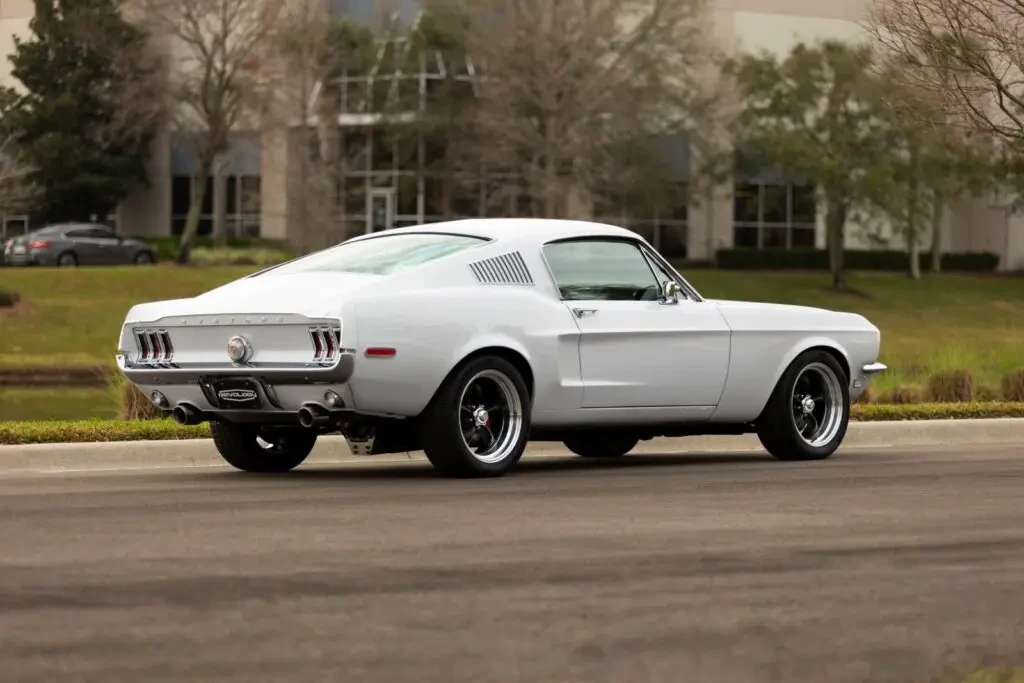
The best color for a Mustang restoration in 2026 is ultimately the one that balances the car’s history with your personal narrative. Whether you choose the cinematic drama of Highland Green, the purity of Wimbledon White, or the modern precision of Porsche Chalk, a Revology reproduction wears its paint differently.
It wears it with the confidence of a modern, engineered machine.
When you see a Revology Mustang on the road, the first thing you notice is the stance. The second is the sound. But the thing that lingers in your memory, the element that captures the light and the emotion, is the color.
Ready to start your journey? Explore our 1967–1969 Mustang and Shelby GT models at Revology Cars. Experience the difference between a replica and a modern-components reproduction.